Google dragged the indexes lower, but much of the market rose. The economy was growing too—although September’s spending figures explained why Americans might struggle to feel the benefit.
Thursday, October 29, 2026 | The Daily Lens
What Today’s Tape Is Saying
If you spent Thursday watching the Nasdaq, you might have thought everyone was selling.
They weren’t.
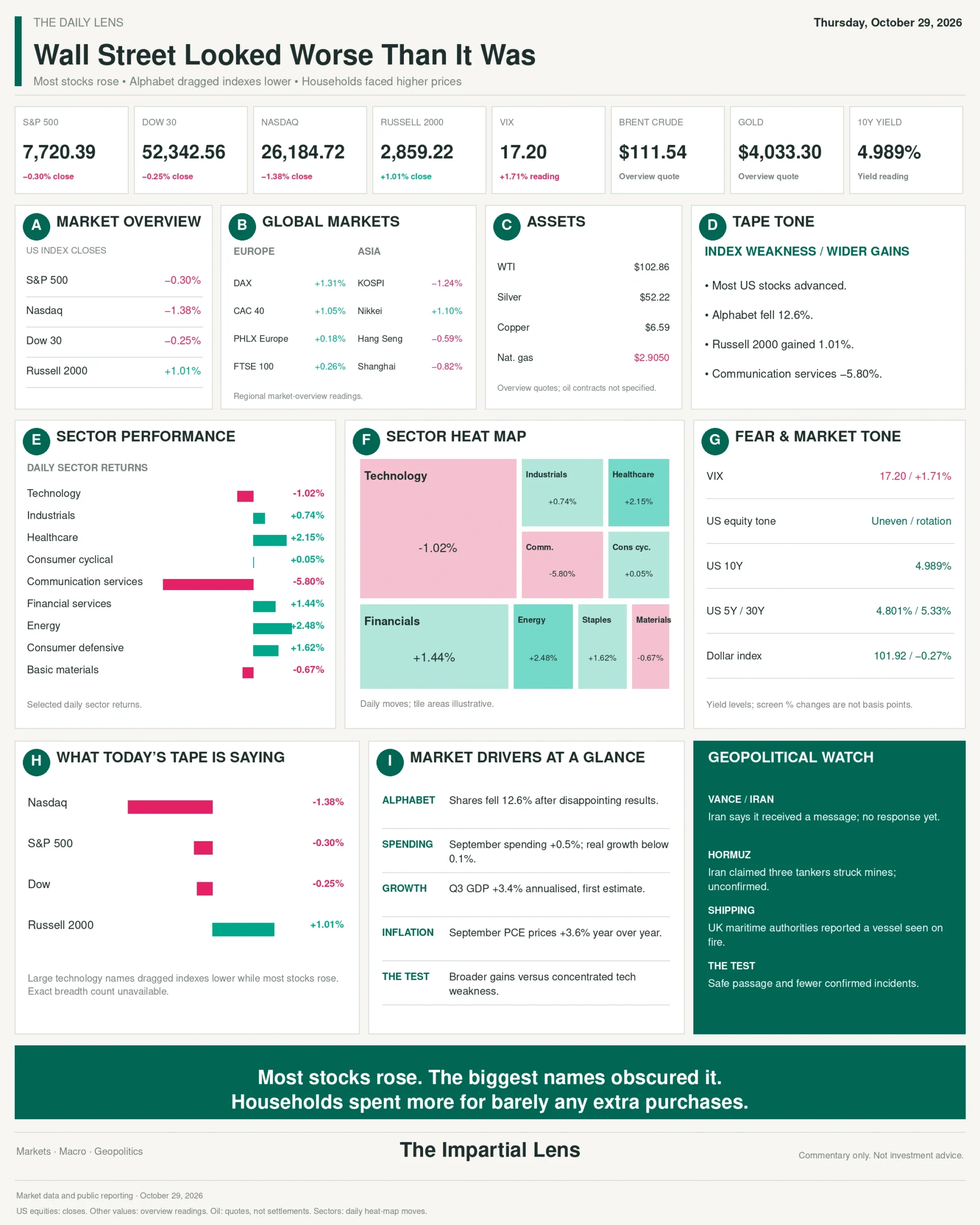
Alphabet, the company behind Google and YouTube, fell 12.6%. That was enough to help pull the Nasdaq down 1.38% and leave the S&P 500 lower. Yet most stocks rose, and smaller American companies had a good day.
| US market | Close | Daily move |
|---|---|---|
| S&P 500 | 7,720.39 | −0.30% |
| Nasdaq Composite | 26,184.72 | −1.38% |
| Dow Jones | 52,342.56 | −0.25% |
| Russell 2000 | 2,859.22 | +1.01% |
Healthcare gained 2.15%, financial services rose 1.44% and energy added 2.48%. Communication services, which includes Alphabet, dropped 5.80%.
The distinction matters. A few enormous companies can make the market look healthier than it is. On Thursday, they helped make it look worse.
There Are Other Businesses Besides AI
Google’s results had arrived after Wednesday’s close. Thursday gave shareholders a full session to reconsider what they were paying for.
The concern was straightforward: growth disappointed while the company was spending heavily on AI. Investors who had been prepared to wait for the rewards became less patient about the expense.
That is an awkward change for a company accustomed to being rewarded for ambition.
As yesterday’s Lens explored, Google has a profitable established business helping finance its expansion. But shareholders still need that expansion to produce worthwhile returns. A busy construction programme is evidence of spending. The earnings eventually have to justify it.
Elsewhere, investors found results they liked. Eli Lilly rose 6.6%, Merck gained 3.8% and Ford jumped 12.4%.
Medicines and motor vehicles rarely attract the same breathless discussion as the next AI breakthrough. They do, however, have customers.
One session does not establish a lasting change in market leadership. But Thursday offered a useful reminder for investors whose attention has narrowed to a handful of technology giants: there are other ways for a business to earn money.
Americans Spent More. They Barely Bought More.
The economic figures looked encouraging at first.
America’s economy grew at a 3.4% annualised pace in the third quarter, according to the first estimate. Investment, consumer spending and government spending contributed to the expansion. Whatever its vulnerabilities, this was not an economy standing still.
September’s household figures explained why people might hear that news without reaching for the champagne.
In other words, Americans collectively spent more and received almost no additional goods and services for the money.
After-tax income grew just 0.2%, while the saving rate stood at 3.8%. Annual inflation, measured by the spending-based index the Fed follows closely, was 3.6%.
There is nothing mysterious about the frustration this creates. A household can be contributing to rising national spending while feeling it is getting nowhere.
For businesses, the next question is what customers cut back on. Electricity, groceries and the journey to work are difficult to avoid. A restaurant meal, a new television or a weekend away can wait.
That is why investors need to look beyond the total amount consumers spend. Higher sales are more reassuring when customers are buying more, rather than struggling to afford the usual purchases.
Vance Sent a Message. Ships Still Needed Safe Passage.
Across the Gulf, diplomacy continued alongside reports of danger at sea.
An Iranian official said Tehran had received a message from Vice President JD Vance but had not yet responded. Meanwhile, Iran claimed three tankers had struck mines in the Strait of Hormuz.
The Associated Press could not independently confirm Iran’s account. British maritime authorities did report that a vessel had observed another vessel on fire while passing through the strait.
These reports require different levels of confidence. They also explain why a diplomatic opening is welcome without yet being enough.
A shipowner deciding whether to send a crew through Hormuz needs more than evidence that officials are exchanging messages. The route has to become reliably safe.
Until then, disruption can keep fuel expensive through delays, insurance and transport costs. Those costs reach haulage companies, manufacturers and households far beyond the Gulf.
A successful negotiation could provide real economic relief. The first people able to judge its practical value may be the crews asked to sail through it.
What the Dashboard Is Telling Us
Look beyond the red Nasdaq figure to the gains in smaller companies, healthcare, financial services and energy. Thursday’s weakness was concentrated rather than universal.
The ten-year Treasury yield also fell, with the reading just below 5%. Lower yields can help borrowing conditions, but one day’s decline offers limited comfort while household prices remain stubborn.
What We’re Watching
- Can the wider market keep rising? Watch smaller companies and the number of S&P stocks advancing when technology struggles.
- Can Google make the spending worthwhile? Watch cash generation and returns from its expansion alongside revenue growth.
- Do households regain some breathing room? Watch spending after inflation and whether the saving rate improves.
- Does diplomacy improve conditions in Hormuz? Watch confirmed shipping incidents and dependable passage, not simply announcements of talks.
The Lens
Thursday supplied two headlines that needed a second look: stocks fell, and the economy grew strongly.
Both were true. Neither told the whole story.
Much of Wall Street rose while Google sank. Americans helped sustain economic growth while spending more for barely any extra goods and services.
For an investor, the useful question is who is actually benefiting. A rising economy does not make every company a winner, and a falling index does not mean every opportunity has disappeared.
Thursday made that unusually clear.
The Impartial Lens provides market commentary and education only. Nothing published here constitutes investment advice.
Featured photograph: New York Stock Exchange, August 2009. Ad Meskens / Wikimedia Commons, CC BY-SA 3.0.
