
An unforgiving earnings season collided with rising energy risk and higher Treasury yields, sending the Nasdaq down 2.15% and exposing the market’s dependence on expensive technology.
Thursday, July 23, 2026
The Tape: What Actually Happened
US stocks finished sharply lower, with the damage concentrated in the market’s largest growth companies.
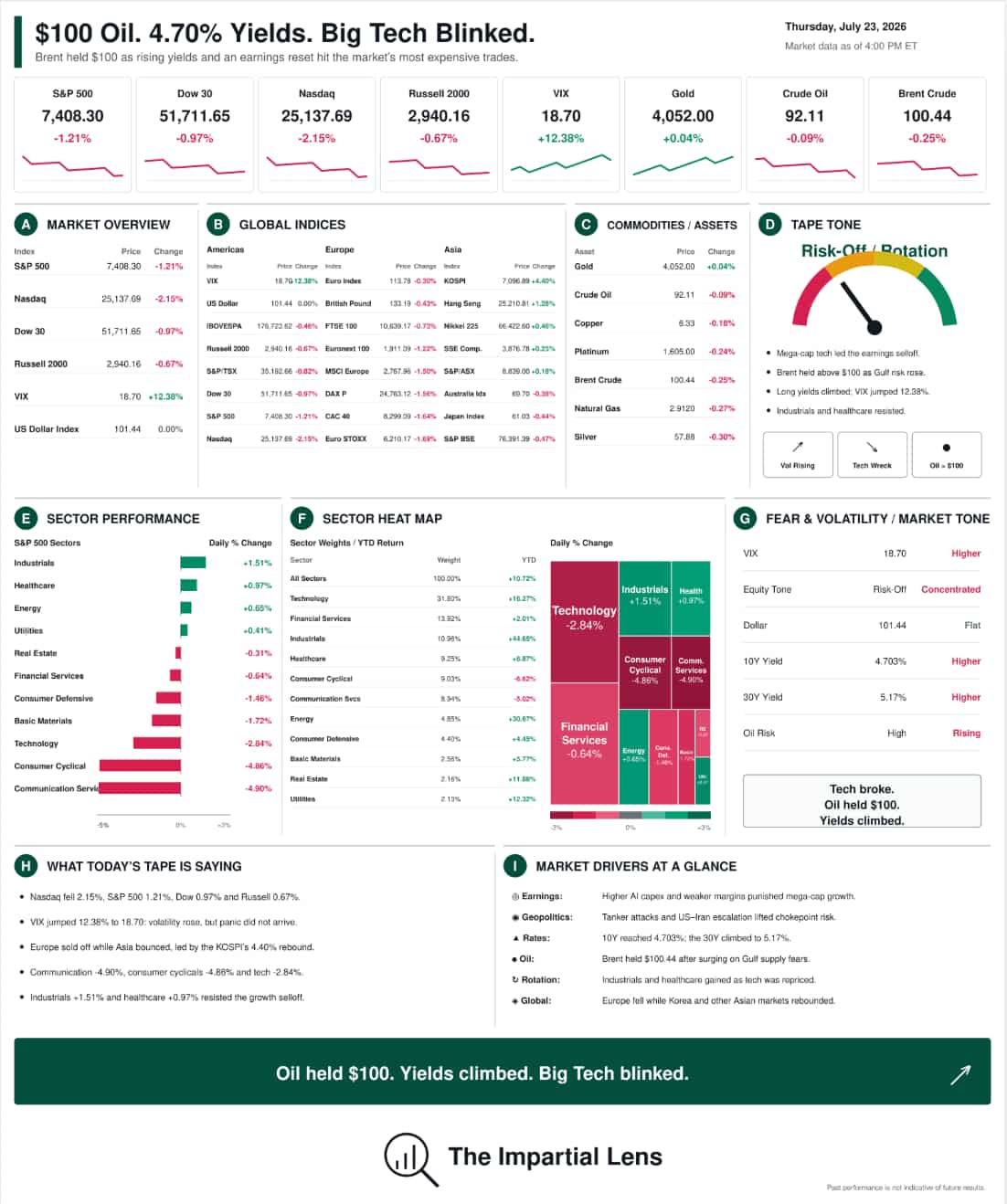
The Nasdaq fell 2.15% to 25,137.69, the S&P 500 lost 1.21% to 7,408.30, and the Dow declined 0.97% to 51,711.65. The Russell 2000 held up slightly better, falling 0.67%.
Volatility returned, but not quite with a vengeance. The VIX jumped 12.38% to 18.70. That was a significant daily move, although the absolute level remained well below what would normally indicate market-wide panic.
The sector breakdown showed that this was not indiscriminate liquidation. Technology fell 2.84%, communication services dropped 4.90%, and consumer cyclicals lost 4.86%. By contrast, industrials gained 1.51%, healthcare rose 0.97%, and energy added 0.65%.
Investors were not selling everything. They were selling the parts of the market carrying the largest expectations.
Bitcoin declined 1.56% to $65,055.77, while gold was almost unchanged at $4,052.
Europe Fell While Asia Bounced
European markets finished broadly lower. The Euro STOXX fell 1.69%, France’s CAC 40 lost 1.64%, Germany’s DAX declined 1.56%, and the FTSE 100 dropped 0.73%.
Asia told a different story. South Korea’s KOSPI rebounded 4.40% after its recent turmoil, while the Hang Seng gained 1.28% and the Nikkei rose 0.46%.
That divergence matters. Thursday was not a synchronized global flight from risk. Asian markets were recovering from earlier losses while the US and Europe were beginning to absorb a fresh combination of earnings, energy and interest-rate pressure.
The geographic sequence changed. The underlying problem did not: markets remain vulnerable wherever positioning, leverage and expectations have run too far ahead of cash flow.
Oil Is Becoming a Rates Problem
Brent finished at $100.44, down 0.25%, while WTI ended at $92.11, down 0.09%. Those closing changes look uneventful, but they conceal the more important development: Brent traded back above $100 as the market added another geopolitical premium during the session.
Treasury yields moved higher alongside oil. The 10-year reached 4.703%, while the 30-year stood at 5.17%.
This is where the energy story becomes a rates story.
Higher oil prices increase transportation, manufacturing and household costs. If those increases persist, they can slow the decline in inflation—or reverse it. That leaves the Federal Reserve with less room to cut interest rates, particularly while the labor market remains resilient.
Reports of another sharp decline in initial jobless claims reinforced that problem. Strong employment is welcome for the economy, but it weakens the argument that monetary policy urgently needs to become easier.
A July rate increase remains far from certain. But the fact that it has returned to the market debate tells us how dramatically the macro environment has changed. Investors began the summer wondering when the Fed might cut. They are now being forced to consider whether an energy shock could produce the opposite result.
Big Tech Must Now Defend the AI Bill
Alphabet beat earnings expectations, but another increase in capital-spending guidance and concerns about near-term margins overshadowed the result. Tesla reported stronger revenue but disappointed on profit.
The message was uncomfortable but straightforward: good numbers are no longer enough when valuations already assume extraordinary execution.
For years, the market treated expanding AI expenditure as proof of future dominance. More chips, more data centers and more borrowing were rewarded because investors assumed monetization would eventually catch up.
That assumption is now being examined rather than automatically applauded.
The AI boom does not have to be imaginary to become a financial disappointment. Companies only need to spend faster than they can generate returns, while investors pay prices that assume the eventual profits will be enormous.
The question is no longer whether AI demand exists. It clearly does. The question is whether future revenue can justify today’s infrastructure bill without crushing margins, increasing debt or diluting shareholders.
Big Tech has spent years selling the future. The market is beginning to ask for receipts.
Geopolitics: The Chokepoints Answer Back
Reports said Houthi forces targeted two Saudi oil tankers in the Red Sea, while US forces completed a twelfth consecutive night of strikes against Iran. President Trump also said he was close to deciding whether to order a substantially larger attack.
Iraq’s new prime minister was reportedly attempting to restart talks by carrying messages between the opposing capitals. That leaves diplomacy technically alive, but operating beneath an accelerating exchange of threats and strikes.
The risk is no longer confined to the Strait of Hormuz. The Red Sea and Bab-el-Mandeb are also part of the equation. Pressure across multiple shipping routes would raise freight costs, insurance premiums and delivery times even without a complete closure.
Markets do not need to lose every barrel of oil before feeling the consequences. They only need to believe that moving those barrels has become more dangerous and expensive.
What to Watch
First, can Brent remain above $100? A brief spike can fade quickly. A sustained move would feed more directly into inflation expectations and corporate costs.
Second, watch the 10-year yield at 4.70% and the 30-year at 5.17%. Further increases would tighten financial conditions without the Federal Reserve doing anything.
Third, earnings must begin answering the AI monetization question. Capital expenditure alone is no longer an adequate investment thesis.
Finally, watch market breadth and volatility. The VIX has awakened, but Thursday’s gains in industrials and healthcare show that investors are still rotating rather than simply running.
The Bottom Line
Thursday brought three problems together: expensive technology, expensive energy and expensive money.
Any one of those can be absorbed. All three arriving simultaneously are considerably harder to ignore.
The market spent years behaving as though cheap capital, secure energy supplies and unlimited patience for AI spending were permanent features of the landscape.
Oil crossed $100. Yields crossed another pressure point. Big Tech discovered that even the future eventually receives a bill.
For educational and informational purposes only. Not investment advice.
— The Impartial Lens