
Three dissenters, surging long yields, an AI liquidation and renewed Iran risk turned Wednesday into a four-front selloff.
Wednesday, July 29, 2026
Wednesday looked less like a trading session than a medieval battlefield at dusk. Stocks retreated, volatility advanced, gold took shelter on higher ground, and the long end of the Treasury market fired over the Federal Reserve’s head.
The Fed did not raise interest rates. Markets tightened financial conditions anyway.
The Tape: What Actually Happened
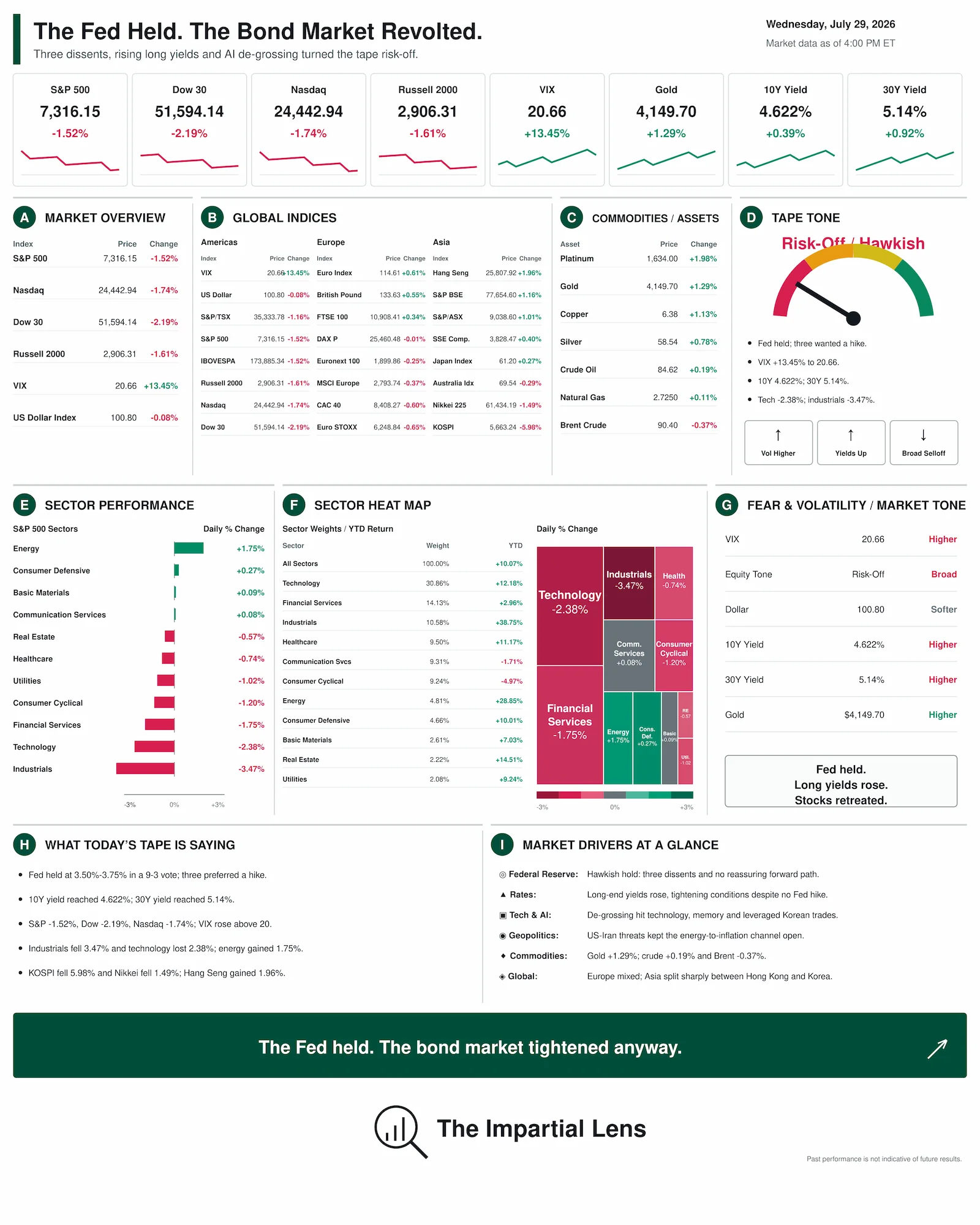
The selling was broad. The S&P 500 fell 1.52%, the Dow dropped 2.19%, the Nasdaq lost 1.74%, and the Russell 2000 declined 1.61%. The VIX jumped 13.45% to 20.66, moving decisively above 20.
Sector performance made the damage even clearer. Industrials fell 3.47%, technology dropped 2.38%, and financials lost 1.75%. Energy was the conspicuous survivor, gaining 1.75%, while communication services finished almost flat.
Gold rose 1.29% to $4,149.70, while the dollar slipped slightly. Crude finished only 0.19% higher, and Brent eased 0.37%. Geopolitical tension returned, but oil did not finish the day pricing an immediate supply catastrophe.
Europe had already closed mixed before the Fed decision: the FTSE 100 gained 0.34%, the DAX was flat, and the Euro STOXX index fell 0.65%.
The Fed Held. The Long End Voted No.
The Federal Reserve kept its policy rate at 3.50%–3.75%, as expected. What markets did not receive was reassurance.
The decision passed 9–3, with Beth Hammack, Neel Kashkari and Lorie Logan preferring a quarter-point increase. The Fed described economic activity as solid and inflation as still elevated, partly because of energy-related supply shocks. It offered little guidance about what comes next.
That combination turned an unchanged-rate decision into a hawkish hold.
The Fed controls the overnight policy rate; it does not dictate the entire yield curve. Investors set longer-term yields according to inflation, growth, government borrowing and future policy.
On Wednesday, the 10-year yield rose to 4.622%, and the 30-year reached 5.14%. The iShares 20+ Year Treasury ETF fell 1.65%.
The bond vigilantes did not merely flash their headlights. They put the Mack truck in gear:
You can hold the short rate. We will decide the long rate.
That hurts equities because long-term yields influence mortgages, corporate financing and the value investors place on future earnings. It is why expensive technology shares can struggle even when the Fed does nothing.
AI Angst Became Forced De-Risking
The AI story did not suddenly become fraudulent. The market simply began demanding answers that enthusiasm had postponed.
Investors are asking whether hyperscalers can convert enormous spending on chips, data centres and power into sufficient cash flow. Reports of widening AI-related credit spreads and heavy semiconductor liquidation suggest the concern has moved beyond valuation and into the financing beneath the buildout.
De-grossing occurs when leveraged investors cut both long and short positions to reduce total exposure. It can push down strong companies alongside weak ones because the immediate objective is not stock selection—it is survival.
Korea remained the warning flare. The KOSPI plunged 5.98%, extending the unwind in a heavily leveraged AI and memory-chip trade. Japan’s Nikkei fell 1.49%. Yet Hong Kong gained 1.96%, India rose 1.16%, and Australia advanced 1.01%. Asia was split; the worst pain remained concentrated around crowded technology exposure.
After the close, Microsoft rose after leaving its capital-spending outlook unchanged. Meta fell after raising its spending forecast again while disappointing on revenue guidance. The market is no longer rewarding expenditure simply because management attaches the letters “AI” to it.
Tehran Added Another Risk Premium
The geopolitical backdrop also deteriorated. President Trump threatened to hit Iran “hard” following reported attacks on US targets in Jordan. Separate reports pointed to possible Chinese weapons support for Iran, threats to Gulf shipping and a drone strike involving a US-owned LNG vessel.
These remain reported developments, not proof of a wider regional war. Crude’s restrained close supports that distinction. Still, investors cannot ignore the transmission chain:
Escalation risk → higher energy costs → stickier inflation → higher long-term yields → lower equity valuations.
Tehran does not need to close a shipping lane to affect markets. It only needs to keep the possibility credible.
What Today’s Tape Is Saying
- This was broad de-risking, not merely another bad day for semiconductors.
- A rate hold is not dovish when three policymakers want a hike and the long end sells off.
- AI spending now requires visible returns; capital expenditure alone is no longer a bullish argument.
- Gold, the VIX and long yields rose together as investors hedged several risks at once.
Market Drivers at a Glance
- Federal Reserve: Rates held at 3.50%–3.75% in a 9–3 decision.
- Bonds: The 10-year reached 4.622%; the 30-year reached 5.14%.
- AI and leverage: Heavy liquidation continued across semiconductors and Korean technology.
- Earnings: Investors rewarded spending discipline and punished unclear returns on AI capital expenditure.
- Geopolitics: Renewed US–Iran threats kept the energy-inflation channel open.
- Oil inventories: US commercial crude stocks fell by 7.2 million barrels and remained about 7% below their five-year seasonal average.
What to Watch Next
The immediate question is whether Wednesday was capitulation or another stage in the unwind. Watch the 10-year yield, the VIX and semiconductor credit spreads together.
If yields ease and technology stabilizes, washed-out positioning could produce a violent rebound. If the 10-year keeps climbing while volatility remains above 20, the market may discover that the Fed’s decision was not a pause in tightening.
It was permission for the bond market to do the tightening instead.
The Impartial Lens provides market commentary and education, not personalized investment advice.