
The Nasdaq rose 1% on the final day, but small caps fell, oil jumped, long yields climbed and defensive shares carried the tape.
Friday, July 31, 2026
Friday’s closing bell painted the major indexes green. It did not erase July.
The Nasdaq gained 1.00%, the S&P 500 rose 0.70%, and the Dow added 0.53%. Volatility retreated, Amazon enthusiasm supported the growth-heavy indexes and South Korea extended its extraordinary rebound.
Look beneath the index headlines, however, and the month ended with an altogether less comfortable message: small caps fell, the technology sector slipped, oil surged, and Treasury yields climbed again.
Friday was relief. July was repricing.
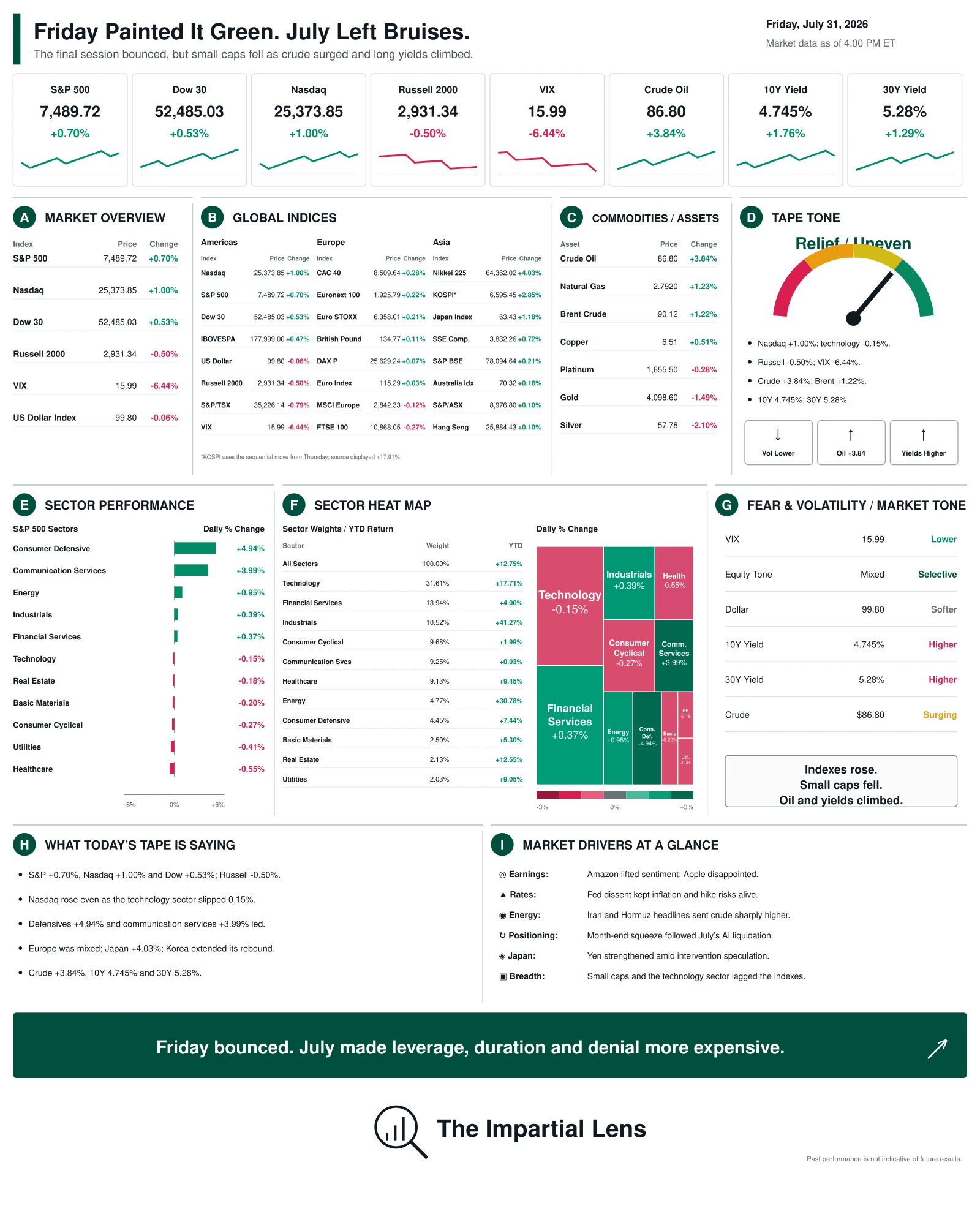
The Tape: What Actually Happened
U.S. indexes closed as follows:
- S&P 500: 7,489.72, up 0.70%
- Nasdaq: 25,373.85, up 1.00%
- Dow: 52,485.03, up 0.53%
- Russell 2000: 2,931.34, down 0.50%
- VIX: 15.99, down 6.44%
- Dollar Index: 99.80, down 0.06%
The sector map was far stranger than those headline numbers suggested. Consumer defensive shares surged 4.94%, and communication services gained 3.99%. Energy rose 0.95%, while technology fell 0.15%, healthcare lost 0.55%, and utilities declined 0.41%.
Yes, the Nasdaq rose 1% while the technology sector fell.
That is not a typo. The Nasdaq contains companies from several sectors. Large communication-services and consumer companies can lift it even when the formal technology sector is weak.
The index was green. The leadership was selective.
July’s Final Scorecard
The Nasdaq ended July down approximately 3.2%, its weakest July in roughly two decades. The S&P 500 finished almost unchanged at about minus 0.1%, while the Dow gained roughly 0.3%. The Russell 2000 lost approximately 3.1%.
The broad market did not collapse, but its most expensive expectations were reset. AI spending came under scrutiny, semiconductor and memory trades unwound, hyperscaler credit weakened, and leveraged positions were exposed.
The fever may have broken. The patient is still sweating.
Bonds Were July’s Uninvited Auditor
The 10-year Treasury yield ended Friday at 4.745%, while the 30-year reached 5.28%. Compared with the end of June, the 10-year yield rose by roughly 26 basis points.
That tightens financial conditions without a Fed rate increase. Higher long-term yields raise borrowing costs and reduce the present value of future earnings—especially for AI companies priced on profits expected years from now.
The equity market spent Friday celebrating earnings. The bond market kept increasing the discount rate applied to them.
The 30-year yield above 5% is no longer a theoretical warning. It is an active cost of capital.
Oil Reintroduced the Inflation Problem
Crude oil jumped 3.84% on Friday to $86.80 in the supplied market snapshot, while Brent rose 1.22% to $90.12. Reported settlement data put WTI’s July gain at roughly 21% and Brent’s at approximately 24%.
Oil finished July as the market’s biggest macro interruption. Reports pointed to possible U.S. attacks on Iranian energy targets, a land blockade and further escalation involving Yemen and regional shipping.
These are reports, not completed events. But higher crude is reviving inflation risk as the Fed debates whether policy is restrictive enough. A sustained energy shock can slow growth while keeping rates high—the combination equity investors least want.
Gold, Bitcoin and the Myth of a Clean Risk-On Day
Gold fell 1.49%, silver dropped 2.10%, and Bitcoin declined 2.80%. Meanwhile, Treasury prices weakened, and small caps fell.
That was no textbook risk-on session. It was a concentrated rebound in selected large companies alongside pressure in rates and alternative assets.
Even the global picture requires care. Europe was mixed. Japan rose strongly, while the yen strengthened amid intervention speculation. The KOSPI reached 6,595.45 and extended its remarkable recovery.
What Today’s Tape Is Saying
- Friday’s index rally was real but narrow. Communication services and defensive shares did the heavy lifting while technology slipped.
- Small caps did not confirm the optimism. The Russell 2000 fell 0.50% and ended July down roughly 3.1%.
- Bonds remain the market’s sternest critic. The 10-year reached 4.745% and the 30-year 5.28%.
- Oil returned as an inflation threat. Friday’s 3.84% jump capped a powerful monthly advance.
- Low volatility did not mean low risk. The VIX fell below 16 even as yields, oil and geopolitical uncertainty rose.
Market Drivers at a Glance
- Earnings: Amazon optimism supported the indexes while Apple weakness reinforced selectivity.
- AI: The trade moved from euphoria to liquidation to squeeze, all within one month.
- Rates: Hawkish Fed dissent and inflation concerns pushed yields higher.
- Energy: Iran, Hormuz and Yemen risks returned crude to the center of the macro debate.
- Japan: Yen-intervention speculation intensified after the Bank of Japan held rates.
- Positioning: July punished crowded trades and exposed the danger of leverage disguised as conviction.
What July Taught Us—and What August Must Answer
July showed that a strong narrative can still produce a violent unwind. AI did not become useless; investors questioned its price, financing and speed of payoff.
August now has three questions to answer:
Can mega-cap earnings outrun rising long-term yields? Can oil remain near $90 without restarting the inflation trade? And can the market broaden beyond a handful of companies without another burst of leverage?
Friday painted the tape green. July left the invoice on the table.
The Impartial Lens separates observable market data from interpretation. This article is for information and education, not personalized investment advice.