
Stocks slipped as Nvidia turned to Wall Street, crude jumped 5%, and Hormuz diplomacy became a compensation dispute.
Monday, August 10, 2026
Wall Street began the week confronting two enormous bills.
Nvidia announced partnerships with six major financial institutions designed to raise more than $500 billion in third-party capital for AI infrastructure.
Meanwhile, hopes for reopening the Strait of Hormuz faded as Iran and the United States traded compensation demands. WTI and Brent jumped roughly 5%.
One bill finances data centres. The other arrives through every fuel pump, freight route and inflation report.
The bond market noticed both.
The Tape: Quiet Indexes, Loud Signals
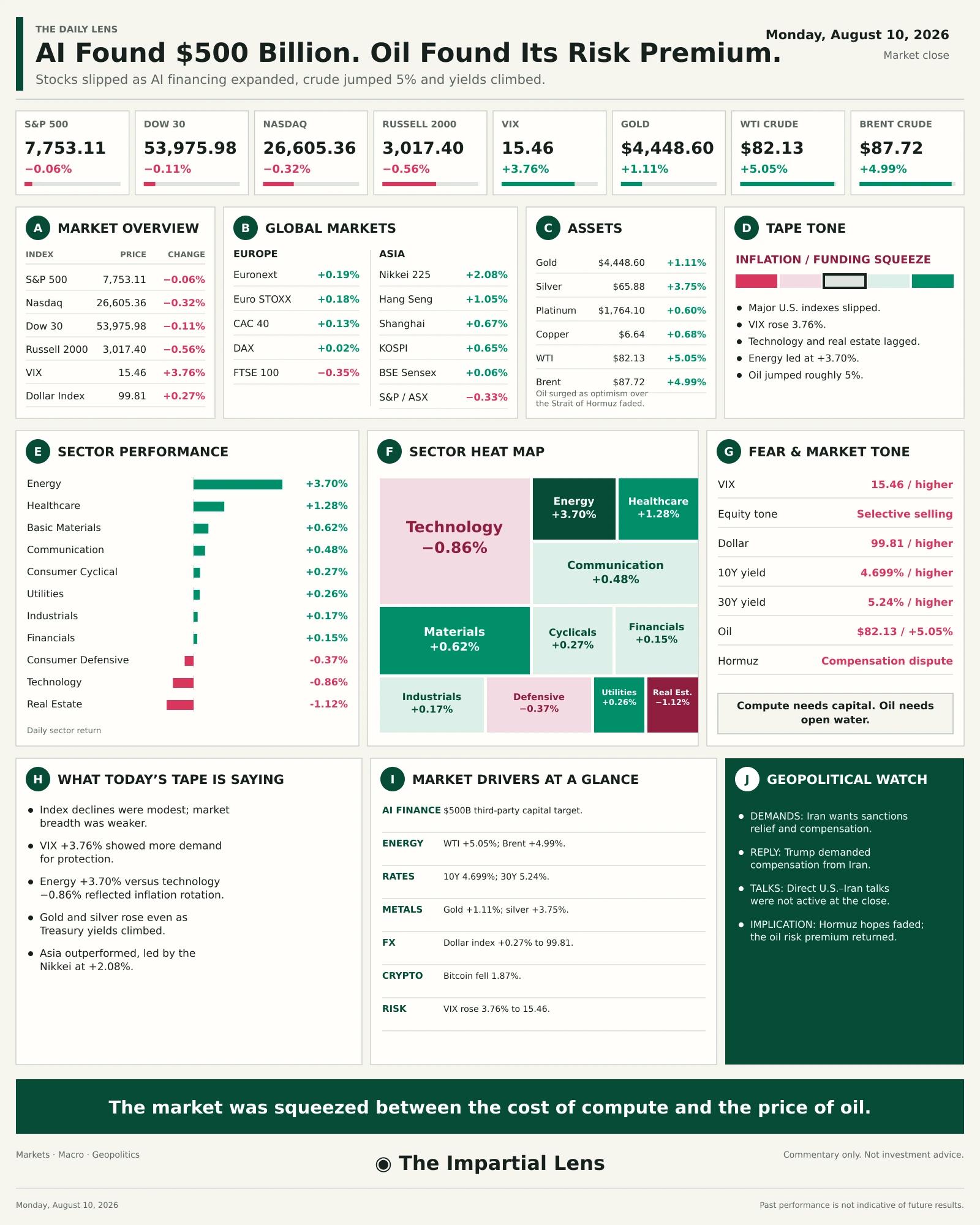
The S&P 500 slipped 0.06% to 7,753.11, while the Nasdaq fell 0.32% to 26,605.36. The Dow declined 0.11%, closing at 53,975.98, and the Russell 2000 lost 0.56% to 3,017.40.
Those moves looked harmless. The internals were less relaxed.
The VIX rose 3.76% to 15.46, declining stocks outnumbered advancers on both major exchanges, and Bitcoin fell 1.87% to $63,926. Technology lost 0.86%, while rate-sensitive real estate dropped 1.12%.
Energy gained 3.70%, healthcare rose 1.28%, and basic materials added 0.62%. Investors were not abandoning risk altogether. They were moving away from expensive duration and toward assets with nearer-term cash flows or inflation protection.
AI Finance: Nvidia Became Part Chipmaker, Part Capital Arranger
Nvidia signed memorandums of understanding with Apollo, BlackRock, Blackstone, Brookfield, Goldman Sachs and KKR. The proposed platforms aim to raise more than $500 billion so AI developers, companies, governments and cloud providers can finance Nvidia-based infrastructure.
This is not a disclosed $500 billion debt sitting on Nvidia’s balance sheet. Financial terms, individual commitments and deployment schedules were not announced.
But the structure still matters. A supplier is helping arrange capital for customers to build facilities filled with its products. That does not make the demand fake. It does make the financing loop more circular.
AI spending becomes revenue that supports valuations, easier financing and still more AI spending.
The flywheel works beautifully—until the return on all that infrastructure fails to arrive quickly enough.
Nvidia fell 2.9%. Intel dropped 4.1% after announcing a separate $15 billion share sale. The market’s message was simple: investors still believe in AI, but they are beginning to inspect the invoice.
Geopolitics: Hormuz Became a Compensation Dispute
Iran said reopening the strait would require the United States to lift sanctions, end military threats and pay compensation for war damage. President Trump countered that Iran owed compensation for people killed or wounded in wars, attacks and protests.
Iran and the United States were not engaged in direct talks when markets closed.
Brent settled 4.99% higher at $87.72, while WTI gained 5.05% to $82.13. Both benchmarks had fallen more than 7% the previous week on expectations that a Hormuz agreement was close.
Monday reversed that optimism. Diplomacy had moved from discussing shipping lanes to arguing over who owes whom for the war.
The U.S. Strategic Petroleum Reserve fell by 6.1 million barrels to 298.7 million, its lowest since January 1983. Houthi and Ukrainian attacks added further supply pressure.
Markets can price a peace announcement quickly. They cannot reopen a waterway by headline.
Macro and Rates: Friday’s Relief Did Not Survive Monday
Friday’s weak jobs report pushed Treasury yields lower. Monday’s oil shock pulled them back up.
The 5-year yield rose to 4.405%, the 10-year reached 4.699%, and the 30-year climbed to 5.24%. The dollar index gained 0.27% to 99.81.
Gold still advanced 1.11% to $4,448.60, while silver jumped 3.75% to $65.88. Higher yields normally challenge precious metals. Their ability to rise anyway suggested persistent demand for inflation and geopolitical protection.
Wednesday’s consumer-price report now matters even more. A hot print combined with $82 oil would make Friday’s lower-rate celebration look premature.
Global Markets: Asia Outperformed
Japan’s Nikkei gained 2.08%, the Hang Seng rose 1.05%, Shanghai added 0.67%, and South Korea advanced 0.65%. Europe was mostly modestly positive, although the FTSE 100 fell 0.35%.
The pressure was concentrated in U.S. technology, duration-sensitive assets and businesses vulnerable to higher energy costs.
What Today’s Tape Is Saying
- The major indexes barely fell, but market breadth and the VIX deteriorated.
- AI’s next phase increasingly depends on capital markets, not just chip demand.
- Technology weakened while energy led, reflecting the return of inflation risk.
- Gold and silver rallied despite higher Treasury yields.
- Bitcoin fell as investors reduced exposure to speculative duration.
- Hormuz optimism evaporated when conditions turned into competing compensation demands.
Market Drivers at a Glance
- AI finance: Nvidia-backed platforms target more than $500 billion in third-party capital.
- Energy: WTI and Brent rose approximately 5%.
- Rates: The 10-year returned to 4.699%; the 30-year reached 5.24%.
- Geopolitics: Washington and Tehran exchanged compensation demands.
- Metals: Gold gained 1.11%; silver rose 3.75%.
- Positioning: Technology and Bitcoin weakened while energy outperformed.
What to Watch Next
Watch Wednesday’s CPI, the 10-year near 4.70%, and whether crude holds above $82. Watch for actual terms and commitments behind Nvidia’s financing platforms—not merely the headline total.
Most importantly, watch physical traffic through Hormuz. Monday’s lesson was blunt: financing promises can build an AI boom, but diplomatic promises cannot deliver a barrel of oil.