
The week ended quietly near all-time highs. Underneath, the consumer weakened, Treasury yields climbed, oil heated up—and the market’s manufactured calm began to look rather less comforting.
Friday looked like a shrug.
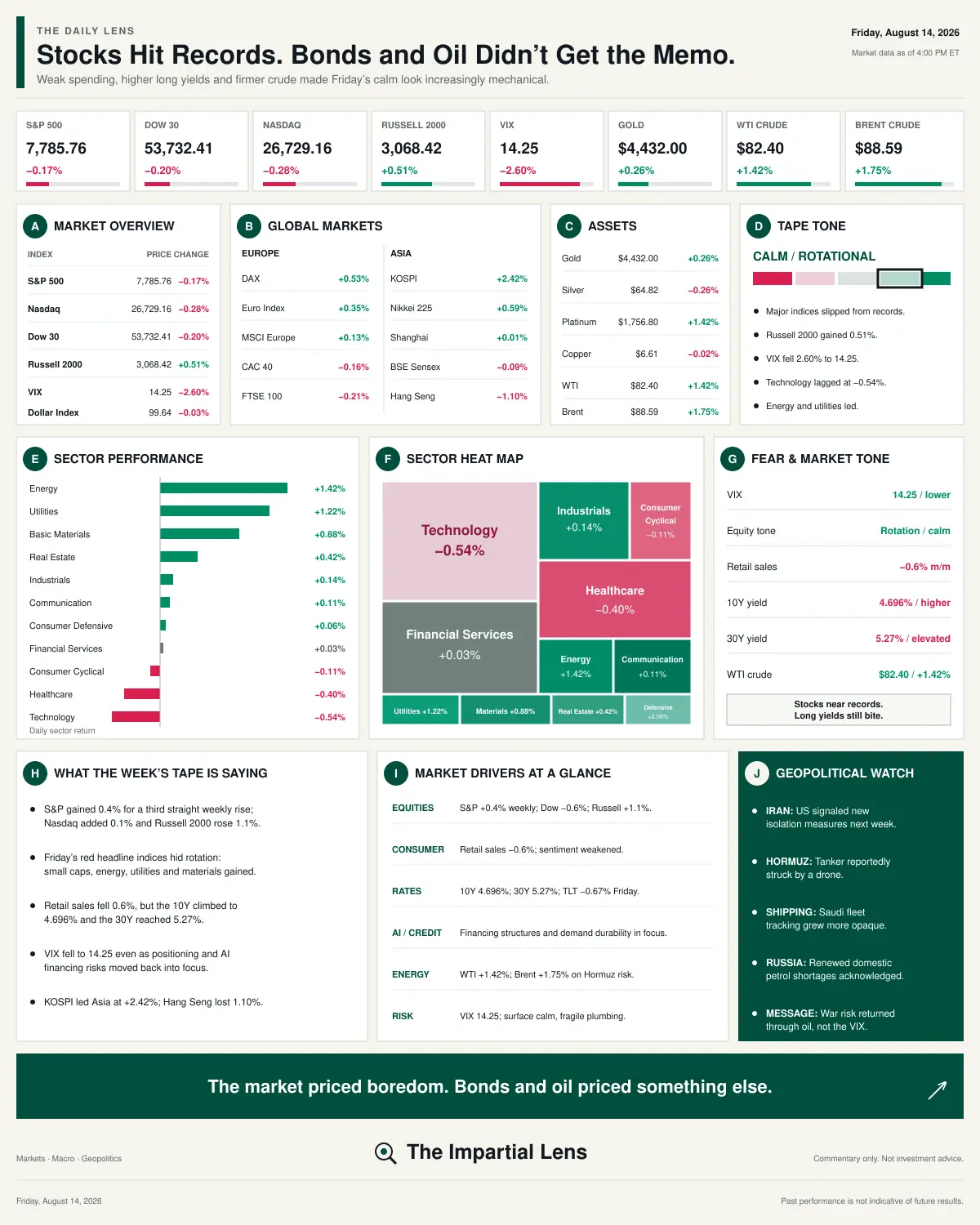
The S&P 500 slipped 0.17%, the Nasdaq lost 0.28%, and the Dow fell 0.20%. Hardly a dramatic finish after the S&P had set another record on Thursday.
For the week, the S&P gained 0.4%, the Nasdaq edged up 0.1%, and the Russell 2000 rose 1.1%. The Dow was the odd one out, falling 0.6%. AP’s closing data confirms just how little the headline indices moved.
But this was not a quiet week.
It was a week in which stocks, bonds, oil and the economic data appeared to be arguing over which version of reality investors should believe.
Goldilocks Met the Consumer
The market spent much of the week celebrating softer inflation.
Producer prices were unchanged in July, employment data had cooled, and expectations for another Federal Reserve rate hike faded. That was enough to push the S&P 500 to a record 7,816.70 on Thursday.
Then Friday delivered another supposedly market-friendly number: retail sales unexpectedly fell 0.6% in July.
Initially, stocks rose. Weaker spending meant less pressure on the Fed to raise rates.
Then the mood changed.
Weak retail sales are helpful only while investors can describe them as “cooling.” Eventually, cooling becomes slowing—and slowing becomes a problem for earnings.
Consumer sentiment also deteriorated, with inflation concerns rising as the conflict in the Middle East re-escalated. The market was being asked to celebrate weaker demand while simultaneously ignoring higher energy costs.
It managed that trick for a few hours.
The Bond Market Wasn’t Buying It
If Friday’s data was genuinely disinflationary, Treasury yields should have fallen.
They didn’t.
The 10-year yield finished around 4.696%, while the 30-year reached 5.27%. The iShares 20+ Year Treasury Bond ETF fell 0.67%.
At the same time, crude oil climbed 1.42% to $82.40, Brent rose 1.75% to $88.59, and energy stocks gained 1.42%.
That is the week’s central contradiction.
The front end of the narrative says the economy is cooling and the Fed can remain on hold. The long end says inflation, borrowing requirements, and geopolitical risk have not disappeared.
For equities, that distinction matters. A Fed pause is helpful. A 30-year yield above 5% is considerably less so.
This Was Rotation, Not Panic
Friday’s red indices disguised a more interesting market underneath.
The Russell 2000 gained 0.51%, while energy, utilities, materials and real estate all finished higher. Technology fell 0.54%.
Meanwhile, the VIX dropped 2.60% to 14.25—its lowest level since December.
Money did not flee the market. It moved.
That rotation was visible in fund flows as well. Investors put a net $2.58 billion into US equity funds during the week, including $8.78 billion into growth funds. Yet technology-specific funds suffered $4.62 billion in withdrawals, while bond funds attracted $9.4 billion. Reuters’ fund-flow data shows investors buying risk, bonds, and protection from concentration at the same time.
Confused? So is the market.
The $300 Billion Trapdoor
The most interesting warning came from Nomura’s Charlie McElligott, who reportedly identified approximately $300 billion of autocallable products generating enormous amounts of short-dated volatility exposure.
Autocallables are structured products that can encourage dealers to sell volatility and hedge in ways that suppress normal market movement. While prices remain comfortably above certain thresholds, those flows can make the market appear remarkably stable.
If those thresholds are approached, however, the hedging dynamics can change quickly and begin amplifying the move.
This is not a prediction that the market is about to collapse. It is a reminder that calm can be mechanically produced rather than fundamentally earned.
A VIX at 14.25 does not necessarily mean risk has disappeared. It may mean risk has been compressed, packaged, and postponed.
AI Is Real. So Is the Financing Risk.
The AI trade supplied the week’s other uncomfortable question.
The bearish argument is no longer that artificial intelligence is useless or that demand is imaginary. The concern is that the infrastructure boom increasingly depends on debt, special-purpose vehicles and financing structures that assume demand will keep accelerating.
That has produced comparisons with the housing-finance machine of 2008.
The comparison is provocative, not proof that AI is another housing crisis. But the underlying question is legitimate:
Can the cash flows arrive before the financing costs do?
Applied Materials falling roughly 5% after earnings was a small reminder that spending more money on AI infrastructure does not guarantee every supplier an endlessly rising share price.
The technology can be revolutionary while the financing becomes excessive. Both things can be true.
Geopolitics Refused to Stay in the Background
Treasury Secretary Scott Bessent said the United States was preparing unprecedented new measures to economically isolate Iran. A tanker was reportedly struck by a drone while leaving the Strait of Hormuz, while Saudi vessels increasingly disappeared from commercial tracking systems.
Elsewhere, Russia rejected Ukraine’s proposed Black Sea shipping ceasefire and acknowledged renewed domestic petrol shortages.
Markets have grown remarkably skilled at treating war as background noise. Oil’s Friday move suggested the background is getting louder.
What to Watch Next Week
The first number is 4.70% on the 10-year Treasury. If yields continue rising despite softer economic data, equities may have to confront the fact that a Fed pause does not automatically produce cheaper long-term money.
The second is $82 crude. A sustained rise would feed directly into inflation expectations, transportation costs, and household confidence.
The third is technology leadership. The indices can remain near records, but the rally becomes more vulnerable if the sector carrying the largest weight begins losing momentum.
Finally, watch the VIX.
The market finished the week pricing boredom. Between fragile positioning, leveraged AI financing, an unsettled consumer and an increasingly dangerous energy corridor, boredom may be the most expensive assumption on the board.