
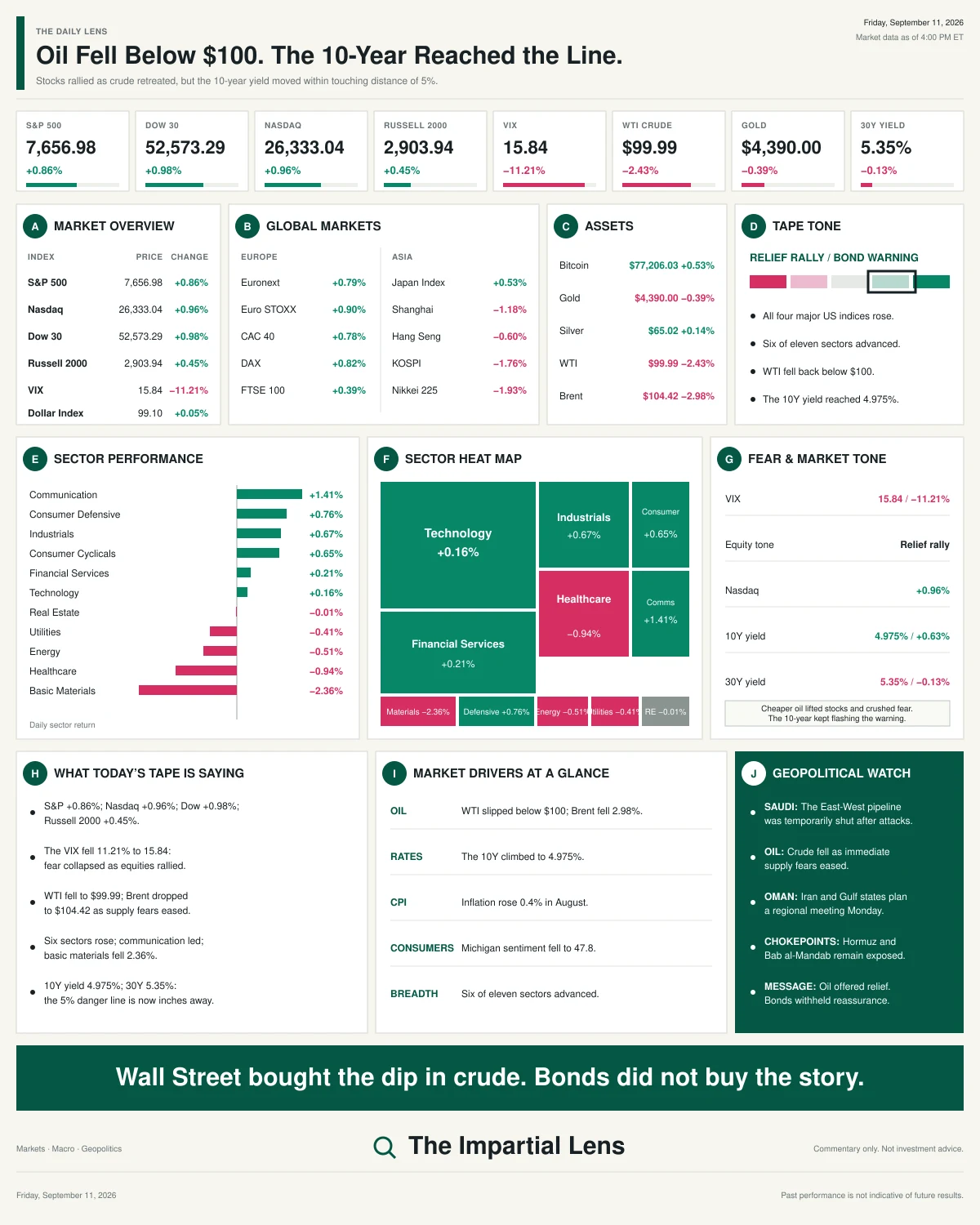
Stocks rallied as crude retreated and fear collapsed. But inflation accelerated, consumers lost confidence, and the bond market pushed the 10-year yield to within touching distance of 5%.
What Today’s Tape Is Saying
Wall Street ended the week by celebrating what did not happen.
Oil did not make another run at $110. WTI fell 2.43% to $99.99, and Brent dropped 2.98% to $104.42. The VIX sank 11.21% to 15.84.
That was enough relief for the S&P 500 to gain 0.86%, the Dow to rise 0.98% and the Nasdaq to add 0.96%. The Russell 2000 advanced a more modest 0.45%.
But relief is not resolution.
WTI may have slipped one cent below $100, but the 10-year Treasury yield reached 4.975%. The 30-year remained at 5.35%, and the five-year climbed to 4.791%.
Our 5% line in the sand is no longer approaching. The market is standing on it.
Inflation Took Away the Fed’s Escape Route
The August Consumer Price Index rose 0.4% during the month and 3.4% from a year earlier. Core prices, excluding the really expensive daily costs of food and energy, increased 0.3% for the month and 2.4% over twelve months, according to the Bureau of Labor Statistics.
Those numbers do not describe runaway inflation. They do describe inflation moving in the wrong direction while energy costs remain exposed to war.
That distinction matters.
The Federal Reserve can look through a temporary oil spike. It cannot comfortably look through an oil shock that spreads into transport, diesel, food, manufacturing and inflation expectations.
Markets spent much of the year hoping weaker growth would deliver lower rates. Friday offered the less pleasant combination: fading confidence, firmer inflation and higher yields.
That is not a soft landing. It is the outline of a stagflation problem.
Consumers Felt the Pressure Before Stocks Did
The University of Michigan’s preliminary consumer-sentiment index fell to 47.8 in September from 51.7 in August. Expectations dropped 11.1% during the month to 45.8, while one-year inflation expectations climbed to 4.6%, according to the university’s Survey of Consumers.
Consumers are telling us something the headline indices are not.
Households experience inflation through petrol stations, electricity bills, groceries and borrowing costs. They do not care that WTI fell 2.43% on Friday if fuel remains dramatically more expensive than it was before the conflict.
Stocks price the next quarter. Consumers pay the current bill.
In April, We Put the Arteries in Focus
Back in April, we published The World’s Arteries Are Now in Focus.
The argument was simple: the global economy may look vast, but its most important flows are squeezed through a surprisingly small number of ports, canals, pipelines and narrow waterways. Markets tend to treat those routes as background infrastructure—until somebody demonstrates control over one of them.
Friday brought that argument back into view.
Saudi Arabia temporarily shut its East–West oil pipeline after drone attacks in the Riyadh and Medina regions. The pipeline carries crude from the kingdom’s eastern fields to the Red Sea port of Yanbu, allowing exports to bypass the Strait of Hormuz. Saudi officials said the attacks caused injuries and that the drones came from Iraq. Riyadh has so far held back from retaliation. Reuters reported the shutdown and the kingdom’s response.
The importance of the attack is larger than the immediate damage.
Hormuz is constrained. Bab al-Mandab is threatened. Now the land route designed to reduce dependence on those waterways has also been hit.
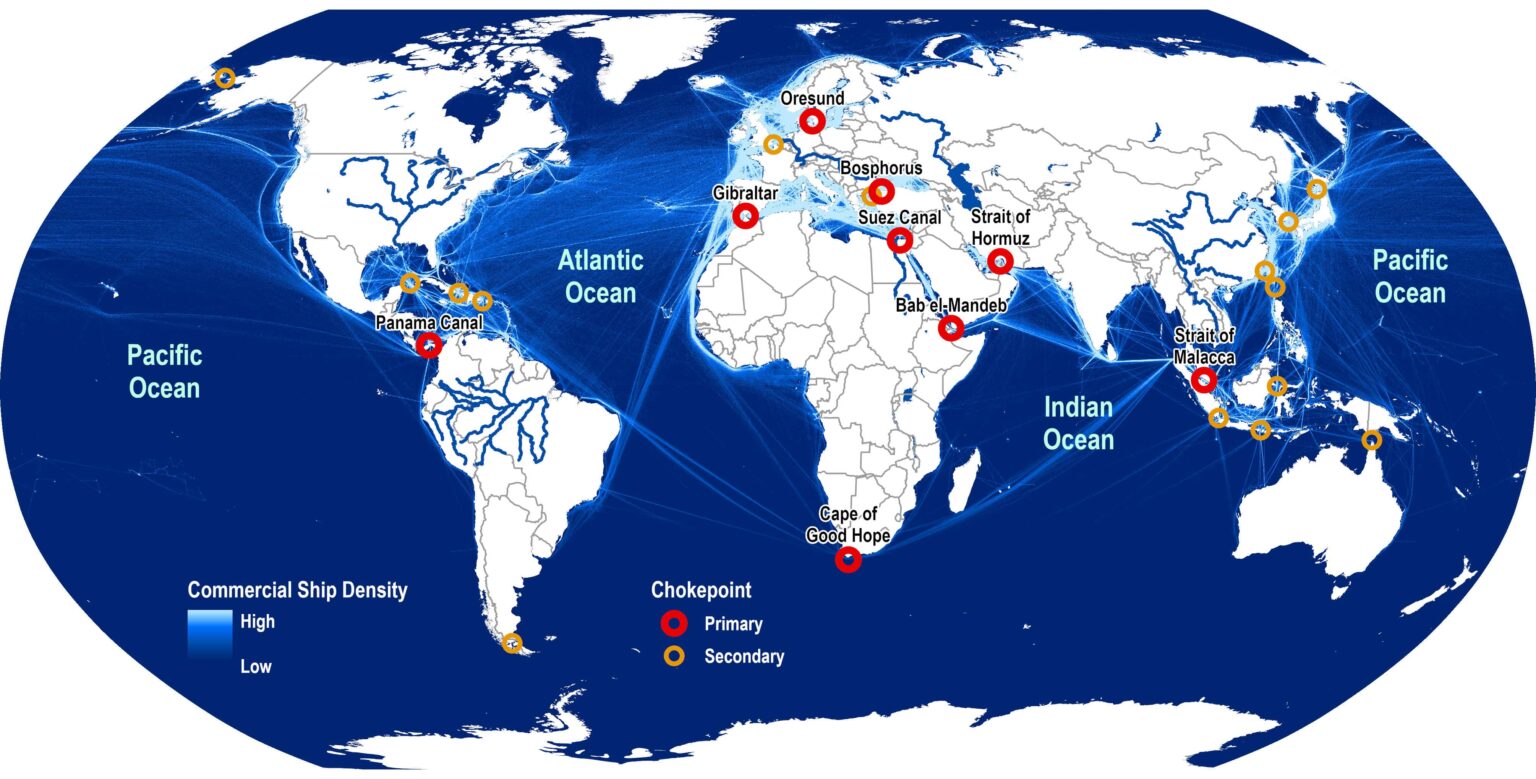
The market is not dealing with one vulnerable chokepoint. It is discovering that the alternatives are vulnerable too.
That is the uncomfortable evolution from April. Then, the risk was concentrated in the arteries. Now the pressure is spreading to the bypasses.
Redundancy only protects the system when the alternative route remains outside the conflict. Once the chokepoint and its workaround are both threatened, spare capacity becomes strategic leverage—and every barrel carries a larger political premium.
Friday’s oil decline reflected hope that Monday’s planned meeting between Iran and Gulf states in Oman could produce a temporary shipping arrangement. That hope is reasonable. Treating it as a settlement would not be.
Diplomacy can lower the risk premium quickly. Repairing damaged infrastructure, rebuilding inventories and restoring confidence in shipping routes takes longer.
The Rally Was Better—But Not Clean
Six of the eleven major US sectors finished higher. Communication services led with a 1.41% gain, followed by consumer defensive at 0.76%, industrials at 0.67% and consumer cyclicals at 0.65%.
Technology rose only 0.16%. Healthcare lost 0.94%, energy fell 0.51%, and basic materials dropped 2.36%.
That was broader than Thursday’s selloff, but hardly an all-clear.
Europe participated, with the Euro Stoxx 50 up 0.90%, Germany gaining 0.82% and France adding 0.78%. Asia told the other side of the story: Japan fell 1.93%, South Korea lost 1.76% and Shanghai declined 1.18%.
For energy-importing Asian economies, expensive oil and high US yields are not abstract risks. They pressure currencies, trade balances and domestic financial conditions simultaneously.
Washington’s Other Yield Problem
With one month left in the fiscal year, the US government had spent $1.97 trillion more than it collected. The cost of servicing the national debt was 13% higher than during the same period last year, according to Reuters’ report on the Treasury data.
Higher yields therefore do more than tighten mortgages and corporate finance. They raise the price of carrying the government’s debt.
That creates an uncomfortable loop: large deficits require more borrowing, more borrowing requires buyers, and reluctant buyers demand higher yields.
Oil prices can retreat overnight. The debt remains, and the interest bill keeps growing.
What to Watch
Monday begins with diplomacy in Oman and ends with the bond market’s verdict.
Watch whether the Strait of Hormuz discussions produce a concrete shipping mechanism rather than another statement of intent. Watch whether Saudi Arabia provides a timeline for restoring the East–West pipeline. Above all, watch the 10-year yield.
A move through 5% would tell investors that Friday’s stock rally was relief from oil—not relief from inflation, fiscal pressure or expensive money.
Wall Street bought the dip in crude.
The bond market did not buy the story.
The Impartial Lens provides market commentary and education only. Nothing published here constitutes investment advice.