Wall Street ended the week near record highs. Beneath the indexes, energy security, sovereign debt, AI finance, and household confidence were all being repriced.
Friday, October 9, 2026 | The Weekly Lens
The Rally That Concealed the Week
Wall Street finished Friday with the sort of numbers designed to calm everyone down.
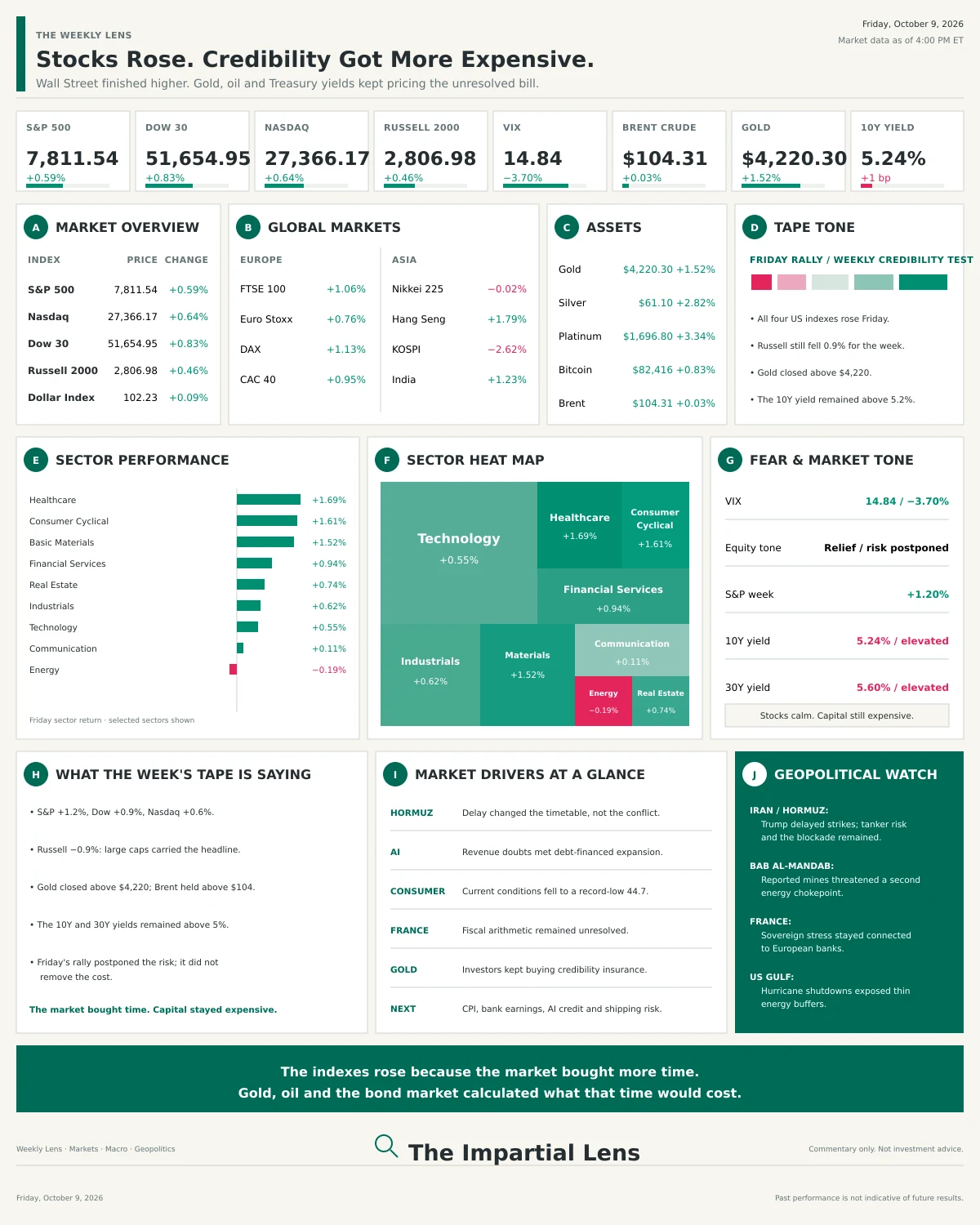
The S&P 500 rose 0.59%. The Dow gained 0.83%. The Nasdaq added 0.64%, the Russell 2000 advanced 0.46%, and the VIX fell 3.70%.
European markets rallied. Healthcare, consumer cyclicals, materials and financials all finished higher. Technology recovered from Thursday’s selloff.
Look only at Friday, and the market appeared to have put the week’s problems behind it.
It had not.
The 10-year Treasury yield still finished near 5.24%. The 30-year remained around 5.60%. Brent crude held above $104. Gold closed above $4,220 after gaining 1.52% on the day.
For the week, the S&P 500 rose 1.2%, the Dow gained 0.9%, and the Nasdaq added 0.6%. The Russell 2000 fell 0.9%.
That final number matters. The largest companies carried the headline indexes higher while smaller, more domestically exposed and rate-sensitive businesses ended the week lower.
The market did not eliminate its risks. It concentrated them beneath a calm surface.
The common denominator was credibility: confidence in secure energy supplies, sustainable government finances and AI revenues large enough to justify the borrowing now required to build the boom.
Each story appeared separate.
The price of capital connected them all.
War Was Postponed, Not Resolved
The immediate catalyst for Friday’s rally was President Trump’s statement that the United States would not attack Iran before the midterm elections.
Markets heard de-escalation.
What they actually received was a timetable.
The strategic dispute did not disappear. Iran’s nuclear position remained unresolved. The Strait of Hormuz remained dangerous. Tankers continued operating under the threat of mines, missiles and seizure.
Reuters reported that attacks on tankers around Hormuz reached their highest weekly level since the war began. Iran also warned that vessels using routes it had not authorized could be pursued beyond the strait.
Reports that Houthi forces had planted mines near Bab al-Mandeb added a second threat to one of the world’s critical energy corridors.
Hormuz controls access to the Persian Gulf. Bab al-Mandeb connects the Red Sea to the Gulf of Aden. Pressure at both chokepoints means the world can move fewer barrels safely, quickly, and cheaply.
That is the vulnerability we examined in The World’s Arteries Are Now in Focus: a supply route is only as dependable as its narrowest—and most exposed—passage.
That cost appears in freight rates, insurance, diesel, jet fuel, and eventually consumer prices.
The United States’ decision to permit immediate imports of Russian diesel offered some relief. China’s reported return to refined-fuel exports helped as well.
But temporary barrels do not repair damaged infrastructure or restore confidence in shipping routes.
Friday’s oil market understood the distinction. WTI finished around $91.55 and Brent near $104.31 even after another burst of diplomatic optimism.
The market is no longer pricing only the availability of crude. It is pricing the reliability of the system that moves, refines and insures it.
AI Met the Price of Money
The week’s second credibility test came from artificial intelligence.
On Thursday, reports that OpenAI’s annualised revenue was approximately $20 billion below the figure previously signalled triggered a sharp selloff across AI-linked stocks.
Some of the discrepancy may reflect different accounting treatments. But the market’s reaction revealed the more important question:
Are AI revenues arriving quickly enough to support the infrastructure being built in their name?
Broadcom, Oracle and SpaceX are reportedly seeking enormous financing packages to purchase advanced chips. The Wall Street Journal reported that the proposed deals include more than $50 billion for Broadcom-linked custom chips and approximately $40 billion for SpaceX.
SoftBank is reportedly seeking another $100 billion from Gulf investors after already drawing on junk bonds, bridge loans, margin loans and Japanese retail capital.
This is a different phase of the AI boom.
When the largest technology companies financed data centres from enormous cash balances, rising yields reduced valuations.
When AI infrastructure is financed with debt, rising yields affect the viability of the projects themselves.
Delayed data centres mean delayed revenue. Delayed revenue weakens cash flow. Weaker cash flow makes refinancing more expensive. More expensive financing demands still greater future revenue.
That circle works while investors believe the growth will arrive.
It becomes dangerous when confidence weakens.
As we argued in Yields Fell. AI Fell Harder, the technology may remain revolutionary while the financing becomes unforgiving.
AI is no longer merely competing with other technology companies.
It is competing with governments for capital.
The Index and the Economy Separated Further
Friday also delivered one of the week’s most uncomfortable economic signals.
The University of Michigan’s preliminary October survey showed consumer sentiment falling to 46.3. Its current economic conditions index plunged from 50.9 to a record-low 44.7.
The S&P 500 ended near a record high on the same day.
Those two facts appear contradictory only if the stock market is treated as the economy.
It is not.
The index is increasingly influenced by a small group of globally dominant companies tied to AI investment. Households live in a different market—one defined by fuel, food, rent, insurance, mortgages and credit-card rates.
One market celebrates future productivity.
The other pays today’s bills.
This divide explains why strong index performance has not repaired public confidence. Asset owners see record prices. Consumers see borrowing costs near multi-decade highs and energy expenses moving through everything they buy.
The market can continue rising while the public feels poorer.
Politically, that is not a stable equilibrium.
Europe’s Problem Did Not Disappear
European equities rallied on Friday, and French bonds temporarily steadied.
France’s arithmetic did not improve.
Its debt burden remains heavy, its political system remains resistant to meaningful spending restraint, and the European Central Bank is already being asked—implicitly and explicitly—how much stress it will tolerate.
ECB officials continue to distinguish between “warranted” market discipline and “unwarranted” disorder. That language matters because intervention is ultimately a political decision disguised as a technical one.
If the ECB suppresses French borrowing costs, it weakens the market’s ability to discipline fiscal policy. If it refuses, higher yields feed losses through banks, mortgages, businesses and government budgets.
We examined that feedback loop in France’s Bond Crisis Is a Warning for Ireland.
France is not yet in a sovereign-debt crisis.
It is in the stage where officials insist that contagion is contained while investors calculate who will absorb the losses if it is not.
Gold Refused to Leave
Gold’s Friday rally may have been the week’s clearest message.
It rose above $4,220 even as equities gained and the VIX fell. Silver advanced 2.82%, platinum gained 3.34%, and copper rose 2.16%.
This was not a simple panic trade.
Gold has no earnings forecast, fiscal programme, or promise to repay. It is nobody else’s liability.
That becomes valuable when investors question several forms of credibility at once:
- Can governments finance expanding deficits without paying materially higher yields?
- Can central banks contain inflation without destabilising debt markets?
- Can energy supplies remain dependable through two threatened maritime chokepoints?
- Can AI revenues arrive before the financing structure becomes strained?
Gold does not answer those questions.
It allows investors to step outside them.
What to Watch Next Week
The calm close leaves several live tests:
- Inflation: A firm CPI reading would revive expectations for another Federal Reserve increase.
- Bank earnings: Results will show whether high yields are producing healthy margins or emerging credit stress.
- AI credit: Watch Oracle, Broadcom, SpaceX and credit-default swaps across the AI complex.
- Market breadth: The Russell’s weekly decline matters more if large-cap technology continues carrying the indexes alone.
- Hormuz and Bab al-Mandeb: Another tanker attack could erase the market’s diplomatic optimism quickly.
- France: Sovereign spreads and European banks remain the cleanest measures of contagion.
- Gold: Continued strength alongside rising equities would reinforce the message that investors are hedging the system rather than a single event.
The Lens
Stocks finished the week higher because investors accepted a temporary pause in several crises.
But a pause is not a solution.
Iran remains unresolved. France still owes the money. AI still needs the capital. Consumers still feel poorer. Washington still needs buyers.
Friday’s rally did not prove that those problems had disappeared.
It proved that markets will postpone a reckoning when given even a narrow excuse.
The indexes rose because the market bought more time.
Gold, oil and the bond market spent the week calculating what that time would cost.
The Impartial Lens provides market commentary and education only. Nothing published here constitutes investment advice.