Washington offered fuel relief. Attacks in Saudi Arabia reminded markets why relief remains difficult. Meanwhile, Chinese chip competition gave the AI trade another reason to examine its promises.
Monday, October 12, 2026 | The Daily Lens
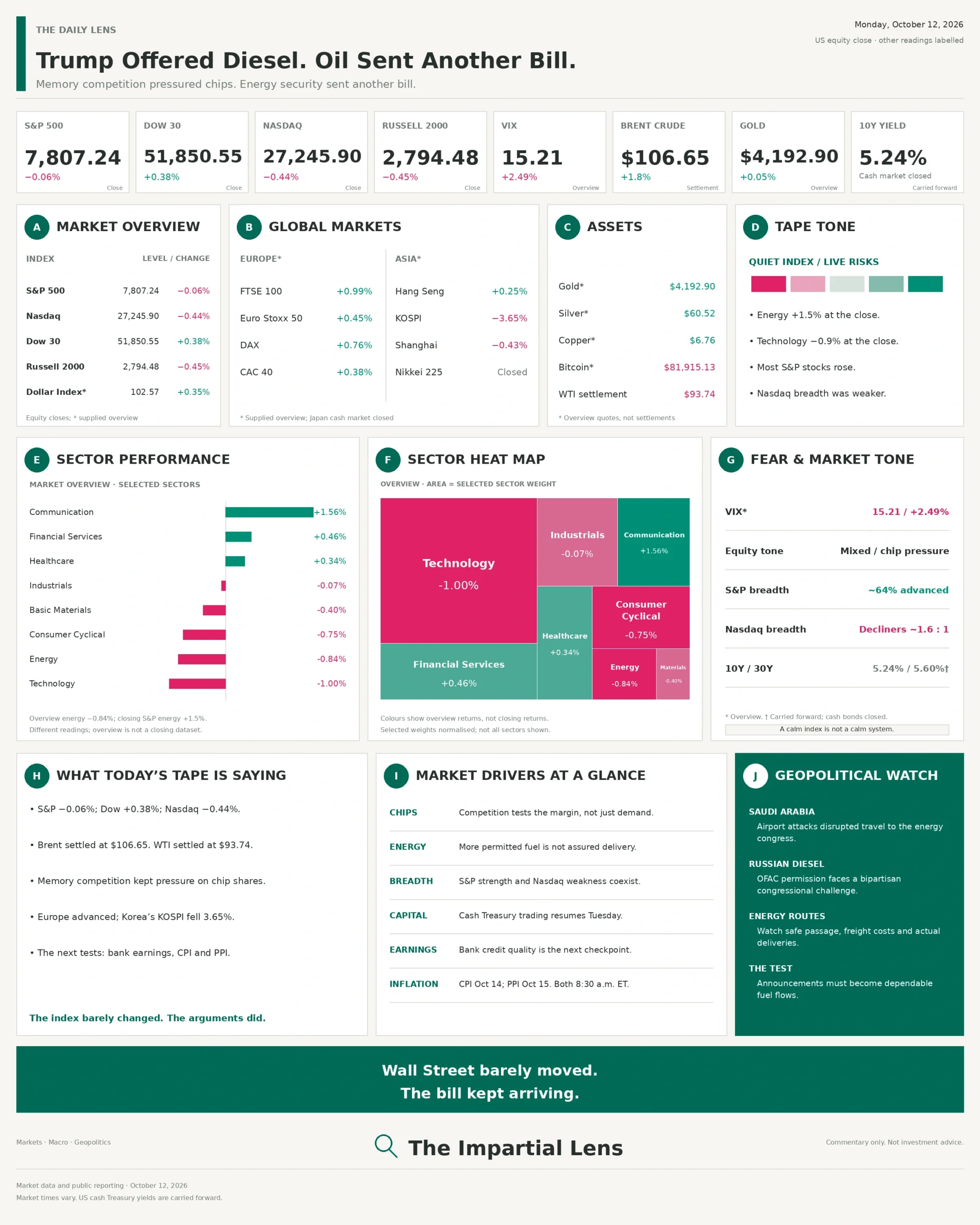
What Today’s Tape Is Saying
The US bond market took Monday off. The oil market declined the invitation.
Brent crude settled at $106.65, up 1.8%, while WTI finished at $93.74. Attacks in Saudi Arabia outweighed the prospect of additional Russian diesel reaching international markets.
Wall Street’s response was more restrained. The S&P 500 slipped 0.06%, the Nasdaq fell 0.44%, and the Dow gained 0.38%. The Russell 2000 lost 0.45%.
Energy shares rose approximately 1.5%. Technology declined 0.9%.
This was no general stampede for the exits. Roughly 64% of S&P companies advanced. Weakness in heavyweight technology shares helped keep the index red while much of the market rose.
The quiet finish left two questions unresolved: could Washington make fuel cheaper, and could chipmakers keep earning the profits investors expected?
The Energy Conference Had a Security Problem
Riyadh was hosting a gathering of the global energy industry when the journey to the gathering became part of the story.
Several major oil-company executives disappeared from the congress programme after attacks claimed by the Houthis. BP said its chief executive could not attend because of travel disruption.
Energy security was among the subjects being discussed. Getting safely to the discussion had become a practical demonstration.
For markets, the concern extends beyond an airport. Saudi Arabia is central to the international oil system. Further escalation raises questions about infrastructure, export routes and the cost of protecting both.
As we explored in The World’s Arteries Are Now in Focus, the world’s energy supply depends on a surprisingly small number of vulnerable passages.
Oil does not need to disappear for energy to become more expensive. Longer journeys, dearer insurance and uncertain delivery schedules can send the bill higher while the barrels still exist.
Washington Reached for Russian Fuel
Against that backdrop, additional Russian diesel has an obvious economic attraction.
Diesel moves trucks, farm machinery and construction equipment. More supply could ease costs that eventually reach food, freight and almost everything delivered to a shop.
Treasury issued a licence on October 9 allowing transactions involving Russian diesel. European diesel futures—contracts used to trade wholesale diesel—fell 2.3% on Monday as traders assessed the prospect of additional supply.
That was useful relief.
It also produced an awkward political picture. Seven bipartisan senators argued that US imports would violate the statutory ban.
Sanctions are intended to constrain Russia. Affordable fuel is intended to keep the American economy moving. Those objectives become uncomfortable companions when Russian fuel is part of the proposed answer.
The economy has a habit of discovering dependencies that foreign policy would rather do without.
Plenty of Oil. Trouble Getting It There.
Monday supplied another revealing detail.
Reuters reported heavy crude accumulating in the Americas while buyers in Europe and Asia struggled for supply. High freight costs and refinery constraints helped prevent available barrels from reaching the markets that needed them.
A barrel in storage cannot teleport into a European truck.
It needs a ship, a suitable refinery and a dependable route to its customer. Each stage adds a cost. When one becomes congested or dangerous, an apparent abundance of oil can coexist with expensive usable fuel.
Businesses then face an unpleasant choice: absorb the increase and earn less, charge customers more, or watch customers reduce their spending.
If those increases spread through the economy, central banks have less room to ease interest rates. Expensive energy can therefore keep borrowing expensive too.
That is how a conflict overseas reaches a household that has never heard of the shipping route involved.
China Added a Different Problem
Technology’s weakness came from another direction.
Reports of progress at Chinese memory-chip maker CXMT pressured established suppliers. Micron fell roughly 3.9%.
Commercial production at scale still has to be demonstrated. But the possibility of stronger competition matters because customers and suppliers want different things from the same AI boom.
A data-centre operator wants plentiful chips at an attractive price. A chipmaker’s shareholders would prefer demand to remain strong enough to protect prices and margins.
Both may believe in AI. They do not necessarily benefit from the same outcome.
Last Thursday’s Yields Fell. AI Fell Harder. examined revenue and financing. Monday added another reminder: a growing industry does not guarantee growing profits for everyone supplying it.
What to Watch
- Does cheaper diesel reach the customer? Watch fuel bills and freight costs.
- Do the attacks stop after the peace announcements? Watch what happens, not just what leaders say.
- Will bonds believe the inflation numbers? CPI Wednesday, PPI Thursday. Watch the response in yields.
- Are bank customers keeping up? JPMorgan reports Tuesday. Look beyond profits to overdue loans.
- Who wins from cheaper chips? AI customers may benefit while suppliers’ margins shrink.
The Lens
Monday’s index barely moved, but the world behind it remained busy.
Washington was trying to make fuel cheaper. Conflict was making delivery less dependable. China was promising more competitive chips, leaving investors to consider whose profits that might improve—and whose it might reduce.
These developments deserve to be followed beyond the announcement.
Wall Street can buy the promise immediately.
The economy gets the benefit when the fuel arrives and the numbers add up.
The Impartial Lens provides market commentary and education only. Nothing published here constitutes investment advice.