
The Nasdaq slipped as yesterday’s AI chase cooled, but cyclicals, Asian equities and gold showed that risk appetite was still very much alive.
Wednesday, August 5, 2026
Tuesday’s everything rally lasted one session before its leadership began to wobble. Semiconductors softened, and the Nasdaq finished lower. But calling Wednesday “risk-off” would miss the tape: the Dow rose, volatility fell, cyclicals rallied, Asian markets surged, and gold broke higher.
FOMO did not leave the building. It simply changed rooms.
The Tape: What Actually Happened
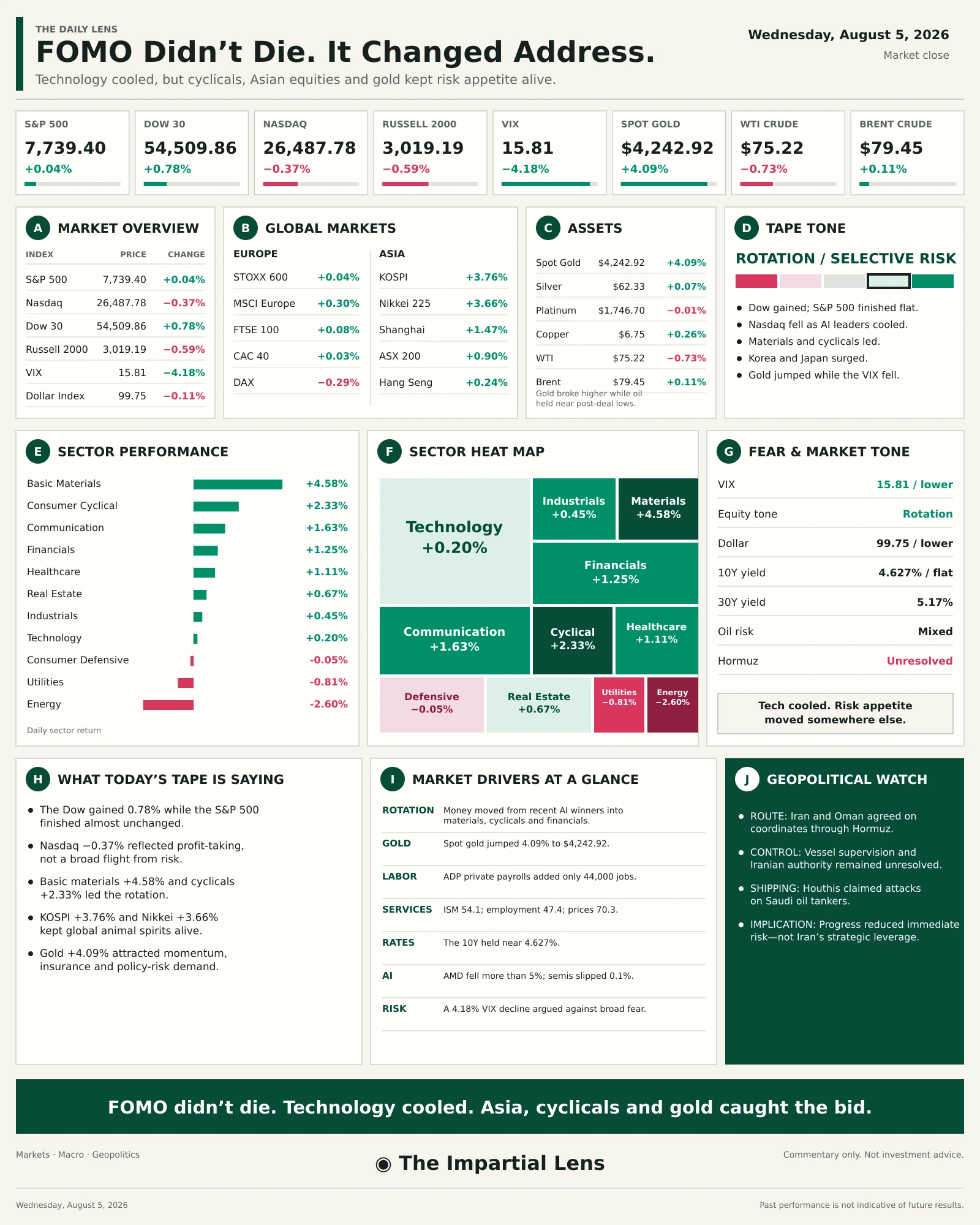
The Dow rose 0.78% to 54,509.86, the S&P 500 finished almost unchanged at 7,739.40, and the Nasdaq fell 0.37% to 26,487.78. The VIX dropped 4.18% to 15.81.
The sector map told the better story. Basic materials gained 4.58%, consumer cyclicals rose 2.33%, communication services advanced 1.63%, and financials added 1.25%. Technology was barely positive at 0.20%, while energy fell 2.60%.
This was not investors fleeing risk. It was investors taking profits from yesterday’s winners and looking for somewhere else to put the money.
Asia Brought the Animal Spirits
South Korea’s KOSPI rebounded 3.76%, while Japan’s Nikkei gained 3.66%. China’s Shanghai Composite rose 1.47%, and Australia added 0.90%.
Europe was quieter. The broader STOXX 600 eked out a fresh record, while the DAX fell 0.29% and the FTSE 100 gained 0.08%. U.S. technology paused, but global risk appetite did not collapse with it.
Gold Stole the Spotlight
Spot gold jumped 4.09% to $4,242.92, its highest level in almost seven weeks.
Gold rising alongside equities is not the classic fear trade. Investors appeared to be buying a softer dollar, geopolitical insurance and protection against policy error simultaneously.
Treasury yields offered little drama. The 10-year yield was essentially unchanged at 4.627%, while the 30-year stood near 5.17%.
Macro: Growth Without Comfortable Inflation
Private employers added only 44,000 jobs in July, down from a revised 95,000 in June. That was the weakest increase in six months.
Yet the services economy was not rolling over. The ISM Services PMI edged up to 54.1, its 25th consecutive month in expansion. Business activity climbed to 59.1, and new orders reached 57.2.
The problem was beneath the headline. The employment index fell back into contraction at 47.4, while the prices index rose to 70.3.
That is awkward for the Federal Reserve: orders remain firm, but hiring is slowing, and input costs are elevated. Weak employment argues against tighter policy. Persistent price pressure argues against declaring victory.
Geopolitics: A Route Is Not a Resolution
Commentary and interpretation
Iran and Oman said they had reached an understanding on the geographic coordinates of a shipping route through the Strait of Hormuz. A joint announcement was reportedly being finalized.
That is progress—not a secure reopening. Iranian control, vessel supervision and possible transit fees remained unresolved. Iran also warned against outside interference, while Houthi forces claimed attacks on Saudi tankers.
The twist is uncomfortable: a deal intended to restore shipping may formalize more Iranian authority over a critical energy corridor. Diplomacy may reduce immediate disruption without removing the underlying leverage.
Oil reflected that ambiguity. WTI settled 0.73% lower at $75.22, while Brent edged 0.11% higher to $79.45. The market expected more supply, but it was not prepared to declare the route safe.
The AI Trade Met the Receipts Test
AMD fell more than 5% despite beating estimates, while SpaceX dropped more than 8% as investors questioned its investment burden. The semiconductor index slipped only 0.1% and remained more than 7% higher for the week.
That is not an AI collapse. It is the market becoming selective—and less willing to reward every company merely for spending heavily near the theme.
What Today’s Tape Is Saying
- U.S. technology paused, but global risk appetite remained intact.
- Falling volatility argued against describing the session as broad fear.
- Materials and cyclicals benefited from rotation out of crowded winners.
- Gold attracted both momentum and geopolitical demand.
- The labor market softened while services inflation remained uncomfortable.
- Hormuz negotiations advanced without resolving control or security.
Market Drivers at a Glance
- Positioning: Investors sold recent AI winners after Tuesday’s squeeze.
- Rotation: Money moved toward materials, cyclicals and financials.
- Macro: Weak hiring collided with firm activity and high input prices.
- Geopolitics: Hormuz progress lowered immediate disruption fears.
- Gold: Dollar weakness and policy uncertainty revived the breakout.
- Risk: A lower VIX showed that hedging demand remained contained.
What to Watch Next
Watch whether semiconductors stabilize after the latest profit-taking. Watch whether gold can hold above $4,200, whether the 10-year remains near 4.63%, and whether actual commercial traffic resumes through Hormuz.
Friday’s employment report now carries more weight. Another weak number would strengthen the slowdown argument, but ISM prices warn that weaker hiring does not automatically produce easier inflation.
Wednesday’s lesson was simple: leadership changed, but risk appetite survived. The next test is whether rotation becomes durable breadth—or merely gives yesterday’s crowded winners time to reload.
The Impartial Lens provides market commentary and education, not individualized investment advice