Attacks on commercial shipping, a constitutional confrontation in Poland and a record cryptocurrency theft exposed risks that reach far beyond the day’s falling share prices.
Friday, October 30, 2026 | The Daily Lens
Most of the money moved in about twenty minutes.
By Friday, Binance was dealing with a roughly $6.3 billion theft—the largest cryptocurrency heist on record. Blockchain investigators attributed the attack to North Korean hackers. The exchange promised to cover the losses.
It was an extraordinary financial-security story on a day already crowded with trouble. Commercial ships faced attacks in two seas. Poland’s president turned his plane around as a confrontation erupted at the country’s constitutional court.
Wall Street was selling technology shares. The wider world supplied several other reasons to pay attention.
Two Wars Are Reaching the Delivery Routes
Qatari mediators returned to Tehran on Friday, offering another opening for negotiations between Washington and Iran. At sea, the evidence remained less encouraging.
Maritime security sources said a small boat had attached explosive devices to a tanker passing through Hormuz on Thursday. The crew survived, the fire was extinguished and the vessel continued its journey. Responsibility remained unclear.
Iran separately claimed multiple tankers had caught fire after using routes it had not authorised. Those claims were unverified.
The danger was not confined to the Gulf. In the Black Sea, the container ship Contship Jet sank after Wednesday’s drone attack off Bulgaria. All 18 crew members were rescued. Who carried out the attack remained unresolved.
These are different conflicts, but they create a common commercial problem. Ships carrying ordinary cargo must navigate military danger. More protection, delays and insurance costs can make goods dearer without a complete blockade.
For energy-importing economies, that pressure reaches transport, manufacturing and household spending. Diplomacy matters because dependable delivery would provide economic relief.
Poland’s Court Fight Is Europe’s Problem Too
President Karol Nawrocki interrupted his flight to Senegal after police deployed around Poland’s Constitutional Tribunal amid a dispute over its leadership.
Donald Tusk’s government described its actions as restoring lawful institutions. Opponents accused it of an unlawful takeover. Notes from Poland reported that even a prominent constitutional scholar critical of the previous administration questioned the legal basis for suspending the court’s leadership.
That makes this more consequential than another noisy political argument.
Europe’s governments need cooperation on security, investment and economic policy. A prolonged confrontation over who can lawfully appoint judges and run a constitutional court makes that cooperation harder.
There is financial history behind the concern. In 2024, the European Commission linked Poland’s judicial reforms to access to as much as €137 billion in EU funding. Friday’s events do not establish a new funding freeze, but they show why institutional credibility has practical economic value.
Poland’s dispute exposes another strain on European cohesion at a time when the continent already needs considerable resolve.
The Binance Theft Has a Geopolitical Dimension
TRM Labs attributed the Binance attack to TraderTraitor, a North Korean hacking group, with high confidence. That remains an investigator’s attribution. Binance said its own investigation had not yet identified the attackers.
The distinction deserves to survive the headline.
Some of the stolen money could be blocked because the companies issuing those digital tokens have a freeze function. Bitcoin and ether have no central issuer able to do that, making recovery more difficult. Freezing assets does not automatically return them to Binance.
That leaves investigators, exchanges and law enforcement trying to prevent stolen funds becoming spendable money.
Recovering or freezing assets helps. It does not erase the security failure—or establish that every customer can immediately access their funds.
How Global Markets Responded
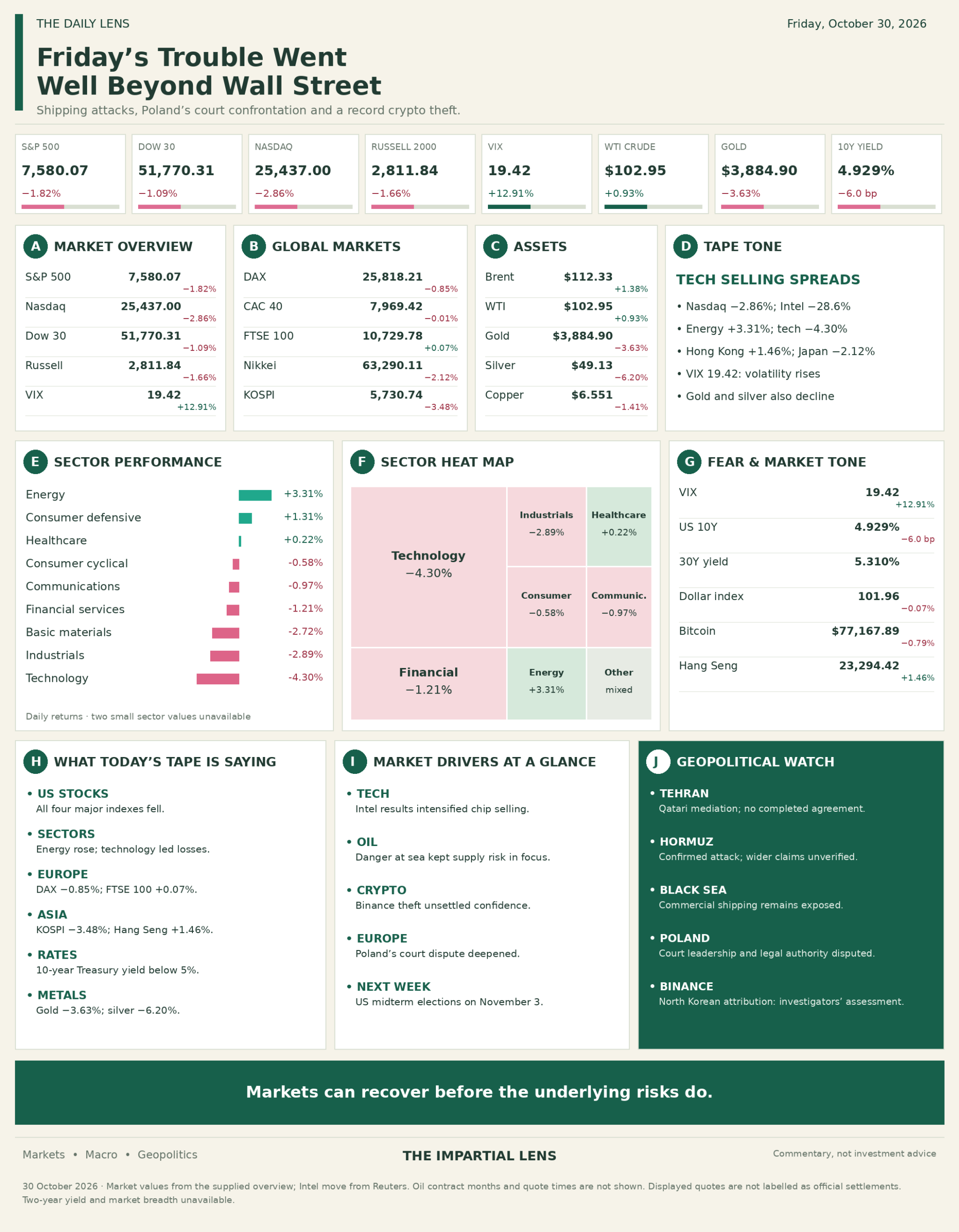
Technology supplied Wall Street’s clearest immediate trigger. Intel plunged 28.6%, and the semiconductor index fell 7.2%. Yet 82% of S&P 500 companies reporting so far had beaten earnings expectations. Investors were punishing particular disappointments within a broadly strong earnings season.
| US market | Friday close | Daily move |
|---|---|---|
| S&P 500 | 7,580.07 | −1.82% |
| Nasdaq Composite | 25,437.00 | −2.86% |
| Dow Jones | 51,770.31 | −1.09% |
| Russell 2000 | 2,811.84 | −1.66% |
All four declined, although smaller companies retained a gain for the week.
Europe’s STOXX 600 fell 0.36%. Earlier in Asia, Japan’s Nikkei lost 2.12% and South Korea’s KOSPI dropped 3.48%. Hong Kong went the other way, with the Hang Seng gaining 1.46%.
What the Dashboard Is Telling Us
The supplied market overview shows VIX at 19.42, up 12.91%. Energy gained 3.31%, while technology fell 4.30%. Gold and silver offered little shelter, falling 3.63% and 6.20%.
The ten-year Treasury yield read 4.929%. Displayed oil quotes were $102.95 for WTI and $112.33 for Brent; these readings are separate from the official contract settlements.
Expensive fuel and falling bond yields reflect competing worries: inflation remains troublesome, while investors become less confident about growth.
What We’re Watching
- Whether negotiations produce safer shipping, alongside further meetings.
- Whether Poland finds a legally credible way through the confrontation.
- What Binance’s investigation establishes about the breach, recovery and customer access.
- Whether selling broadens beyond technology—or other businesses hold up—as the US midterm elections approach.
The Lens
A strong earnings season can coexist with a more dangerous world. Profits alone cannot secure the routes, institutions and financial systems those businesses depend on.
The next market rally may be perfectly justified. We should still ask what has actually become safer. If the answer is only that share prices have recovered, the underlying problems remain.
The Impartial Lens provides market commentary and education only. Nothing published here constitutes investment advice.
Featured image: Azadi Tower, Tehran, at sunset, 17 May 2025. Photo: Norman Thomas (Herokk), via Wikimedia Commons, CC BY-SA 4.0. Image resized for display; any cropped version is shared under the same licence.
