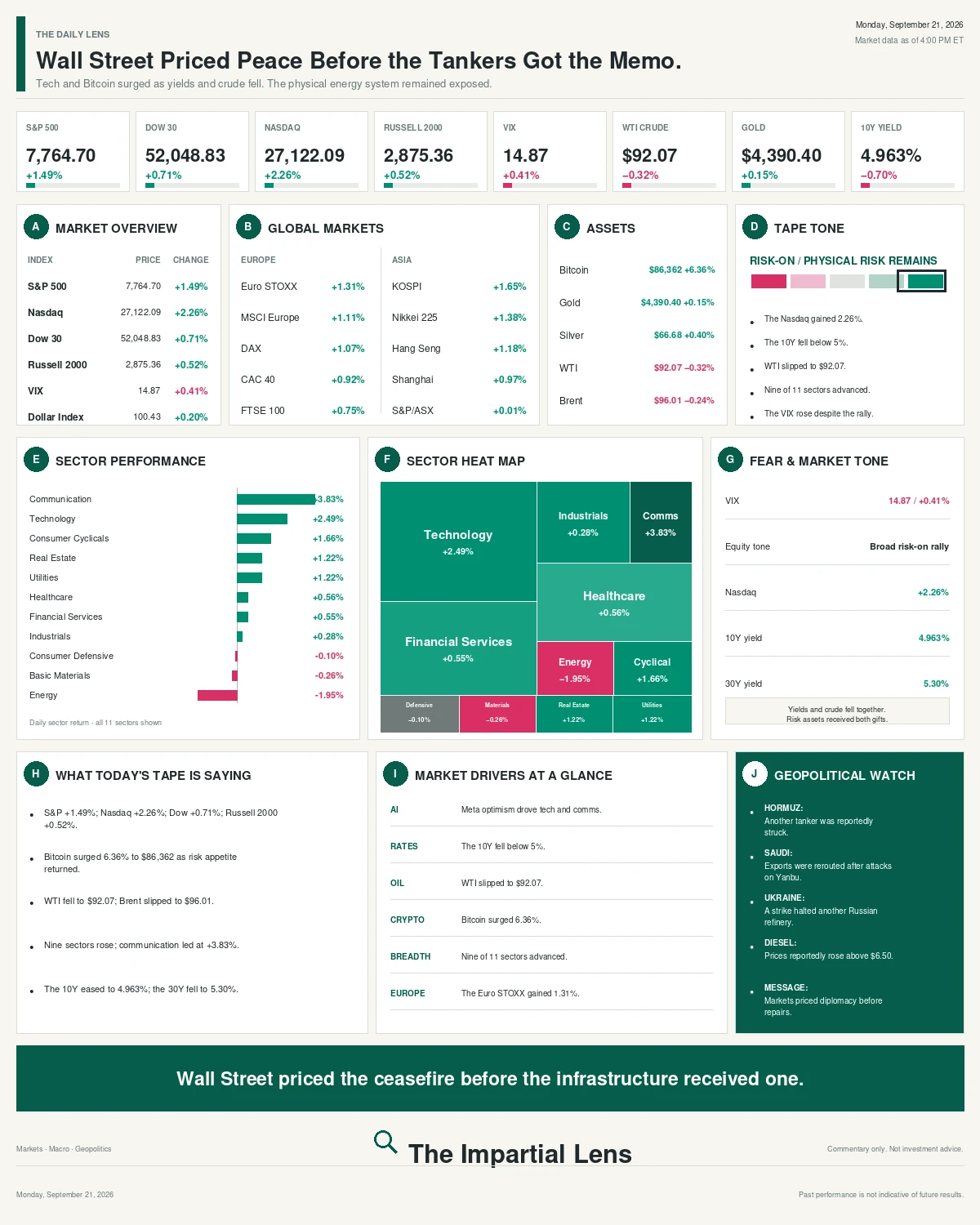
Technology, Bitcoin and global equities surged as yields and crude fell. But diesel hit a record, another tanker was reportedly struck, and two wars kept squeezing the same fuel system.
What Today’s Tape Is Saying
Wall Street began the week by buying the future it wanted.
The S&P 500 rose 1.49%, the Nasdaq gained 2.26%, and the Dow advanced 0.71%. The Russell 2000 added a more restrained 0.52%. Meta’s AI-driven surge helped communication services climb 3.83%, while technology gained 2.49%.
Bitcoin jumped 6.36% to $86,362. Gold barely moved, rising 0.15% to $4,390.
The relief came from two places. Treasury yields eased, with the 10-year slipping back below 5% to approximately 4.96%. Crude also fell: WTI declined 0.32% to $92.07, and Brent lost 0.24% to $96.01.
Lower yields reduced the discount rate applied to future earnings. Lower crude suggested less immediate inflation pressure. Big technology received both gifts at once.
But the VIX rose slightly to 14.87, and the dollar gained 0.20%. Neither move signaled panic. Together, however, they suggested that the celebration was not entirely carefree.
The Market Bought Diplomacy
Investors were encouraged by the possibility of movement on several fronts: US-China talks, speculation surrounding the UN General Assembly and hopes that Washington and Tehran could find a temporary off-ramp.
Markets are allowed to price probabilities before events occur. That is their purpose.
The problem begins when a diplomatic possibility is treated as repaired infrastructure.
Another tanker was reportedly struck in the Strait of Hormuz, even as crude traded lower on hopes of talks. Saudi Arabia was reportedly rerouting exports after attacks affected Yanbu, the Red Sea terminal served by the kingdom’s East-West pipeline.
That pipeline was supposed to reduce dependence on Hormuz. Pressure on Yanbu demonstrates the weakness we identified in April in The World’s Arteries Are Now in Focus: an alternative route is only useful while the alternative remains secure.
The market lowered the price of the barrel. It did not reopen a strait, secure a terminal or repair a pipeline.
Crude Fell. Diesel Did Not Get the Message.
The most important energy price may no longer be crude.
Diesel reportedly rose above $6.50 as fears of export restrictions intensified. That matters because crude and refined products are not interchangeable. An economy can have access to oil while still suffering from insufficient capacity to turn it into diesel, gasoline, and jet fuel.
Ukraine struck another major refinery near Moscow, reportedly halting operations. The military logic is clear: refineries produce fuel for Russia’s economy and war machine.
The market consequence is less tidy.
Removing Russian refining capacity tightens an already stressed diesel market. Europe is particularly exposed because it lost much of its former Russian supply and now competes for replacement barrels moving through vulnerable Middle Eastern routes.
One war threatens the shipping lanes. The other damages the refineries.
Europe pays both bills.
This is why Washington is reportedly pressing Kyiv to restrain attacks on Russian refineries. It is not necessarily a change of sympathy. It is recognition that the same strike can weaken Russia strategically while raising fuel costs for Western consumers.
War can be militarily rational and economically inflationary at the same time.
A Better Rally—With an Old Weakness
Monday’s advance was broader than some recent technology-led rallies. Nine of eleven US sectors rose. Financials gained 0.55%, healthcare added 0.56%, and real estate climbed more than 1%.
Energy fell 1.95%, making it the clear loser as crude weakened. Basic materials and consumer defensives also declined.
European markets joined the rally. The Euro Stoxx index gained 1.31%, MSCI Europe rose 1.11%, the DAX advanced 1.07%, and France’s CAC 40 added 0.92%. Asian markets were mostly higher as well.
That breadth deserves respect. It does not require surrendering judgment.
The Federal Reserve can influence the cost of money, and falling yields can reprice equities quickly. But as we noted after the latest policy decision in The Fed Hiked. The Bond Market Kept Tightening, monetary policy cannot manufacture diesel, escort tankers or rebuild damaged refining capacity.
What to Watch
Three signals matter next.
First, watch whether the 10-year yield can remain below 5%. Monday’s rally benefited from the retreat, but one session does not settle the bond market’s argument over inflation, deficits and supply.
Second, watch refined products rather than crude alone. If diesel remains elevated while oil falls, the market is not signaling abundant energy. It is signaling a bottleneck between the barrel and the consumer.
Third, watch whether diplomacy produces physical results: safer passage through Hormuz, restored Saudi export capacity, or fewer refinery disruptions. Headlines can remove a risk premium in minutes. Repairing the system takes longer.
Monday was a strong day for risk assets. It may even prove to be the beginning of a durable advance.
But Wall Street priced the ceasefire before the infrastructure received one.
The Impartial Lens provides market commentary and education only. Nothing published here constitutes investment advice.