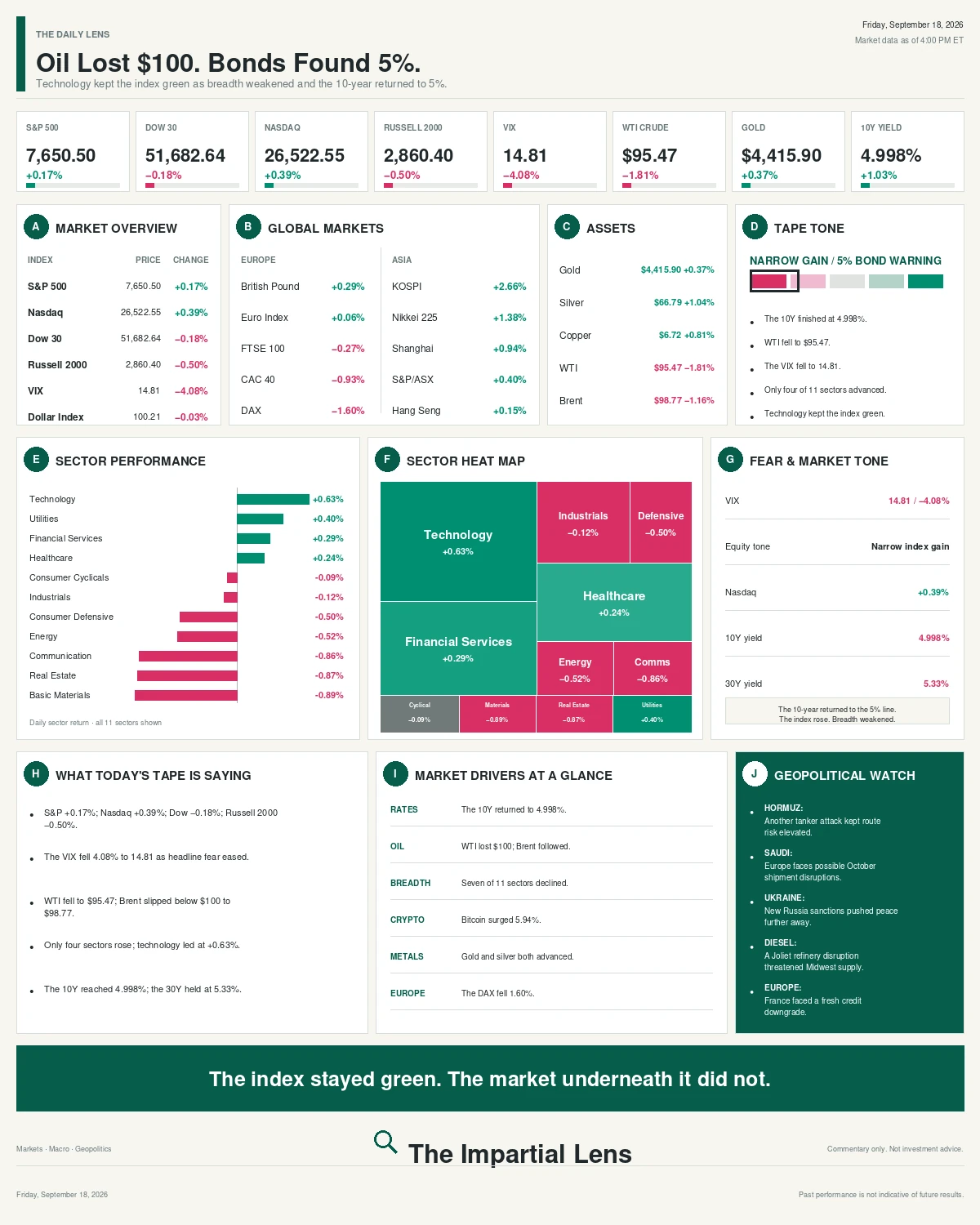
Technology kept the index green as market breadth weakened, Treasury yields returned to the danger line, and Europe learned again that cheaper oil does not mean secure energy.
What Today’s Tape Is Saying
Wall Street finished an extraordinary week with a deceptively quiet close.
The S&P 500 gained 0.17%, and the Nasdaq rose 0.39%. But the Dow slipped 0.18%, the Russell 2000 fell 0.50%, and seven of the eleven major US sectors finished lower.
Technology gained 0.63% and did most of the work. Financial services rose 0.29%, healthcare added 0.24%, and utilities advanced 0.40%. Everywhere else, the tape was weaker. Communication services fell 0.86%, real estate lost 0.87%, basic materials dropped 0.89%, and energy declined 0.52%.
The index was green.
The market underneath it was not.
That distinction matters after a week in which the Federal Reserve raised its policy rate, oil moved through $100 in both directions, and the 10-year Treasury yield repeatedly tested the market’s tolerance for tighter financial conditions.
The VIX fell 4.08% to 14.81. Volatility said relief. Breadth said concentration.
The Fed Moved Once. The Bond Market Kept Moving.
The week’s defining number was not the S&P 500. It was 5%.
The 10-year Treasury yield ended Friday at 4.998%, almost exactly on the line markets have spent days debating. The five-year reached 4.856% and the 30-year held at 5.33%.
The Federal Reserve raised its target range by 25 basis points, but long-term borrowing costs are set by investors assessing inflation, growth, deficits and the compensation required to hold US debt.
That is why the 10-year matters beyond the bond market. It influences mortgages, corporate borrowing, equity valuations, and the discount rate applied to future earnings.
The Fed moved the overnight rate.
Bond investors kept the price of money near 5%.
As we argued in The Fed Hiked. The Bond Market Kept Tightening, monetary policy and financial conditions are related—but they are not the same thing.
Oil Fell. The Energy System Did Not Heal.
WTI crude fell 1.81% to $95.47. Brent dropped 1.16% to $98.77.
That sounds like relief after a week dominated by war, disrupted shipping, and vulnerable infrastructure. But the price of a barrel and the security of the system carrying it are two different things.
Saudi Arabia reportedly warned European refiners of possible shipment disruptions in October. Another tanker was reportedly attacked near the Strait of Hormuz. In the United States, a disruption at Exxon’s Joliet refinery raised concerns about diesel availability and prices across parts of the Midwest.
The US Energy Information Administration describes Hormuz and Bab al-Mandeb as critical oil-transit chokepoints. Their importance does not disappear because crude falls for one session.
Europe remains caught between those routes and the continuing damage to Russian refining capacity from the war in Ukraine. New US sanctions on Russia may increase economic pressure, but they also push a negotiated settlement further away. Europe therefore faces risk at both ends of the diesel system: crude and products entering from the south, and refining capacity being disrupted to the east.
This is the argument we first made in The World’s Arteries Are Now in Focus. Markets often price each disruption as a separate headline. The physical system experiences them together.
Gold, Bitcoin and the Search for Another Door
Gold rose 0.37% to $4,415.90 and silver gained 1.04% to $66.79. Bitcoin surged 5.94% to $80,887.
Part of crypto’s move followed the SEC’s Innovation Exemption for tokenized US stocks, which opened a path for certain on-chain trading venues under temporary conditions.
But the broader message was also revealing. After a week of central-bank tightening, geopolitical escalation and volatile energy prices, investors bid both bullion and digital assets.
They were not buying the same instrument for the same reason. They were looking for alternatives to the same uncertain system.
What to Watch
Three signals matter next week.
First, can the 10-year move decisively below 5%, or has that level become the market’s new center of gravity?
Second, can the rally broaden beyond technology? A rising index supported by a shrinking group of sectors is less reassuring than the headline suggests.
Third, does oil’s decline reflect improving supply—or simply a temporary discount on persistent geopolitical risk?
Friday provided cheaper oil, lower volatility, and a higher S&P 500.
It did not provide resolution.
Oil lost $100.
Bonds found 5%.
The risks survived both.
The Impartial Lens provides market commentary and education only. Nothing published here constitutes investment advice.