Stocks recovered on Thursday, but soaring freight costs, threatened oil routes and a stubborn inflation report told a less comfortable story about the price of keeping the world moving.
Thursday, October 15, 2026 | The Daily Lens
What Today’s Tape Is Saying
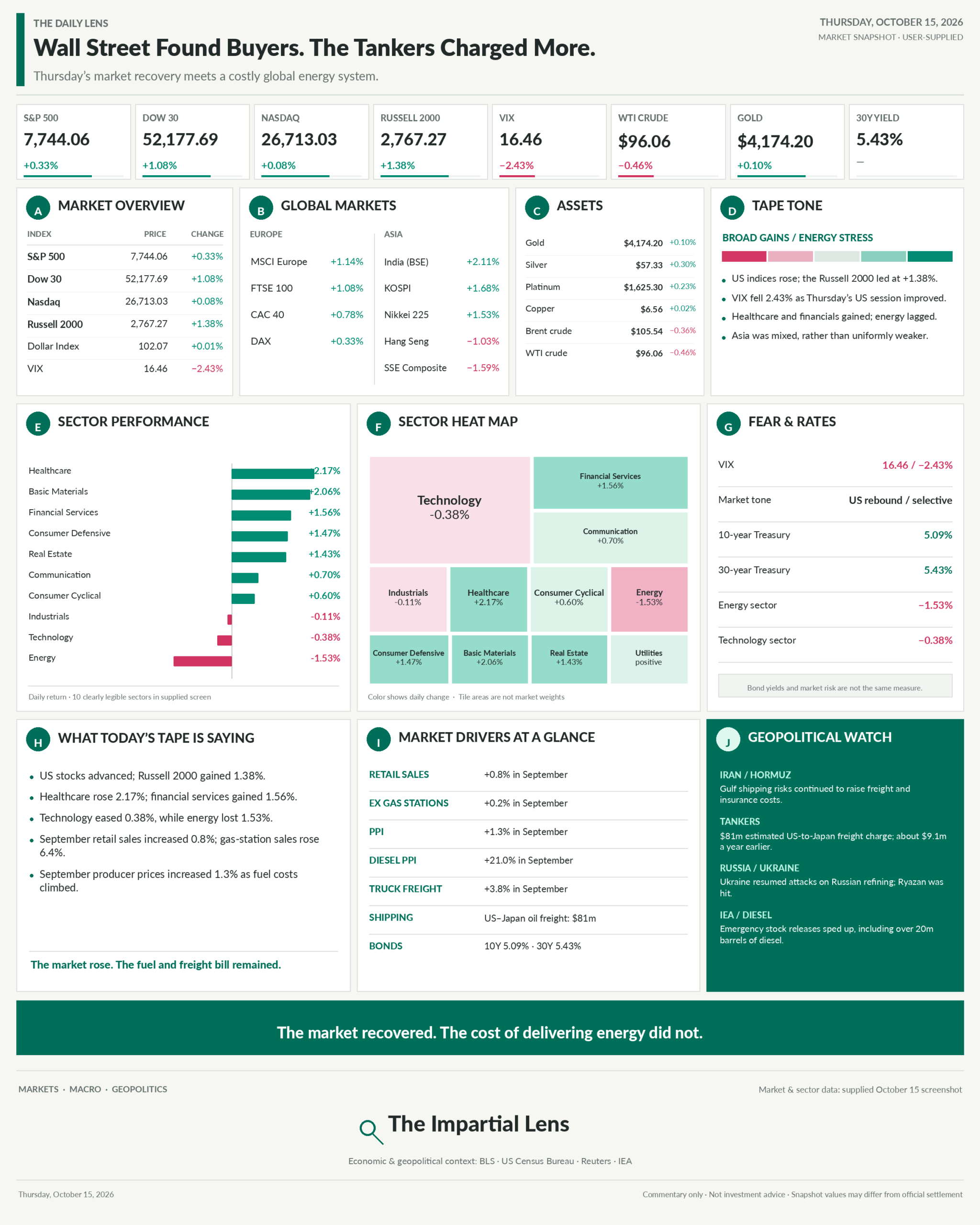
Wall Street was in a better mood by Thursday’s close. The S&P 500 gained 0.33%, the Dow rose 1.08%, and the Russell 2000 advanced 1.38%. The Nasdaq, after another unsettled session for AI-related shares, managed a 0.08% gain.
Our market overview showed healthcare rising 2.17%, financial services 1.56%, and consumer defensive shares 1.47%. Technology slipped 0.38%, while energy fell 1.53%.
This was no general rush for the exits. Investors found opportunities beyond AI, while the VIX fell 2.43% to 16.46.
Treasury yields retreated too, with our screen putting the 10-year near 5.09% and the 30-year at 5.43%.
But Thursday’s strongest economic story was happening a long way from Wall Street: on ships, at refineries and eventually at the petrol pump.
| October 15 market overview | Level | Daily move |
|---|---|---|
| S&P 500 | 7,744.06 | +0.33% |
| Dow Jones | 52,177.69 | +1.08% |
| Nasdaq | 26,713.03 | +0.08% |
| Russell 2000 | 2,767.27 | +1.38% |
| VIX | 16.46 | −2.43% |
| Brent crude | $105.54 | −0.36% |
| WTI crude | $96.06 | −0.46% |
| 10-year Treasury yield | 5.09% | — |
| 30-year Treasury yield | 5.43% | — |
Sector rotation: healthcare +2.17%; basic materials +2.06%; financials +1.56%; consumer defensive +1.47%; technology −0.38%; energy −1.53%.
The $81 Million Passage
The Esteem Explorer, a supertanker preparing to carry approximately two million barrels of crude from the United States to Japan in late November, has an extraordinary freight bill.
Reuters reported a cost of $81 million. The average price for that journey a year earlier was about $9.1 million.
The oil itself costs extra. This is simply what it will cost to move it.
The ship isn’t travelling through Hormuz. That’s the point. Attacks and restrictions around the Gulf have disrupted routes, reduced available tanker capacity and driven up costs far beyond the conflict zone.
As Monday’s Lens examined, crude can be available and still cost a fortune to deliver. Then it must be refined and transported again as usable fuel.
Thursday’s market screen showed Brent around $105.54 and WTI at $96.06, both slightly lower at that reading. The energy sector fell too. Neither move tells us whether the cost of delivering usable fuel has returned to normal.
Two Wars, One Fuel Problem
The war involving Iran is disrupting traffic around Hormuz, a passage central to international energy trade. The risks affect insurance, sailing routes and the availability of ships even when a particular vessel escapes attack.
Russia and Ukraine added another complication on Thursday.
Reuters reported that Ukraine struck Russia’s Ryazan oil refinery after President Volodymyr Zelensky said Kyiv would no longer observe the proposed energy truce. He cited continued Russian attacks on Ukrainian energy infrastructure. Moscow disputes the account of that truce.
Ukraine sees Russian refining as part of Moscow’s ability to wage war. Washington, meanwhile, has been seeking more diesel supply to ease an expensive international fuel market. Those aims do not sit comfortably together.
The United States is even considering easing restrictions on some sanctioned tankers if they carry permitted cargoes. The proposal could increase shipping options, though analysts question how many ageing vessels could actually re-enter mainstream trade. It has not been adopted.
Sanctions are meant to impose costs on adversaries. Fuel relief is meant to reduce costs at home. With freight rates soaring, the two objectives are increasingly colliding.
September’s Numbers Showed the Cost
The US producer-price report arrived Thursday with another warning. Prices received by producers rose 1.3% in September, the biggest monthly increase since March 2022. Annual producer inflation reached 6.3%.
Energy led the increase, but costs were spreading. Gasoline producer prices rose 20.3%, diesel prices 21.0%, and truck-freight transportation prices 3.8%.
These are September figures; Thursday’s developments cannot explain them retrospectively. They show why relief may remain difficult.
A haulier facing higher diesel costs can accept less profit, charge customers more or cut spending somewhere else. A supermarket receiving those deliveries faces its own choices. The costs may arrive gradually, and not every increase is passed on, but there is no magic place where they disappear.
The retail-sales report offered a revealing companion statistic. Spending rose 0.8% in September, beating expectations. Yet sales at petrol stations rose 6.4%. Excluding those stations, sales increased only 0.2%.
That distinction is easy to miss. Retail sales count dollars spent, not how much more people can afford to buy. A driver paying more to fill the same tank makes the sales figures look stronger without becoming better off.
A higher cash-register total is not always a healthier customer.
The Emergency Cupboard Opens Again
On Thursday, the International Energy Agency agreed to accelerate releases from previously pledged emergency stocks, including more than 20 million barrels of diesel.
That can help. But these are largely earlier commitments being delivered faster, not a newly discovered source of production. Emergency reserves can bridge a shortage; they cannot keep a shipping lane safe or repair a refinery.
Treasury yields fell despite the hot inflation report. That is no declaration of victory over inflation: bonds also respond to expectations for growth, interest rates and risk.
The Fed can influence the cost of money. It cannot reduce the cost of a voyage by announcing that it would prefer cheaper diesel.
What to Watch
- The ships, not just the barrels. Are freight and insurance rates falling, and are vessels moving more freely through the Gulf?
- Diesel deliveries. Do emergency releases and refinery operations improve actual supplies, or simply postpone another shortage?
- Prices beyond fuel. Do transport costs continue feeding producer and consumer inflation?
- The shape of the rally. Can financials, healthcare and smaller companies keep participating while technology stabilises?
The Lens
Thursday was a constructive day for stocks. Buyers returned, volatility eased, and more of the market participated. Those are developments worth recognizing.
But the economy does not run on an index quote. It runs on ships arriving, fuel being refined, goods being delivered and customers being able to pay.
An $81 million freight bill is an unusually vivid reminder of what happens when war and scarce transport capacity make all of those jobs more expensive.
Wall Street found buyers on Thursday. The rest of the world still has to pay for delivery.
The Impartial Lens provides market commentary and education only. Nothing published here constitutes investment advice.
Featured image: APILIOTIS oil tanker leaving Tinos, Greece (illustrative, photographed in 2024). Photo: Jules Verne Times Two / julesvernex2.com / CC BY-SA 4.0. No changes to the photograph.
